
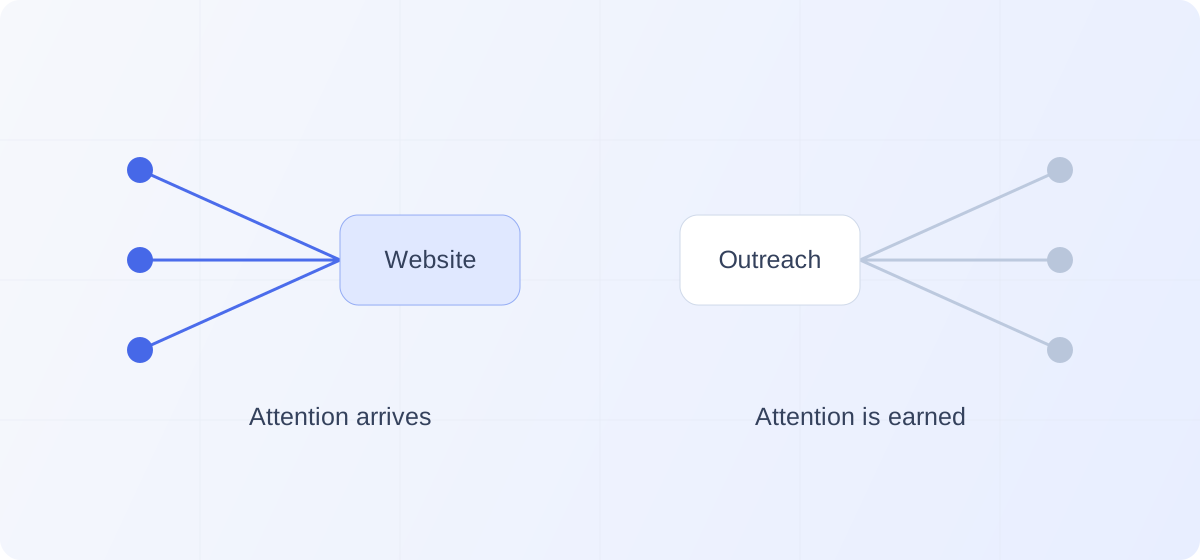
TL;DR: Outbound AI SDRs start with a target market and work to earn a prospect’s attention; inbound AI SDRs help prospects already on your website get answers, assess fit, and move forward. Some products do both, so compare actual workflows. Start with your most expensive unresolved problem: reaching new prospects, helping those already arriving, or fixing follow-up.
An AI SDR automates sales development work, such as prospecting, responding to leads, qualifying prospects, and booking meetings. Depending on the product, that work can happen through outbound outreach, inbound engagement, or both.
An inbound AI SDR focuses on the conversation with prospects who have already reached your website: answering questions, understanding fit, and helping qualified prospects move forward.
Some products marketed as AI SDRs perform exactly this inbound website role. Qualified, for example, describes Piper as an AI SDR that engages website visitors and generates inbound pipeline.
The useful distinction is where the work begins.
Are you trying to reach more prospective customers, or help more of the prospects already reaching you?
Both can produce pipeline. They require different work.
Two pipeline problems that look similar on a dashboard
Imagine two B2B companies missing their pipeline targets.
The first has a well-defined market, a compelling offer, and a team that struggles to reach enough relevant people. There are good potential customers who have never heard of the company. Research and outreach take more time than the team has available.
The second already attracts relevant prospects. People reach its product, pricing, and integration pages. Some request a meeting. Others leave with unanswered questions about whether the product will work for them.
Both companies want more pipeline.
But giving them the same solution would ignore why the pipeline is missing.
For the first company, increasing relevant outreach may be the priority.
For the second, improving the experience after a prospect arrives may create more value than adding another prospecting system.
This is where a conversation about AI sales products should begin. Before comparing features, identify the work your current process is failing to complete.
What an outbound AI SDR does
An outbound AI SDR starts with a target market and works toward a conversation.
That can involve identifying suitable accounts, finding relevant contacts, researching their circumstances, preparing outreach, managing follow-up, and responding when someone expresses interest.
For example, 11x describes Alice’s outbound workflow around identifying accounts, researching prospects, personalizing outreach, and engaging across channels. The product also handles replies and meeting booking. Those are the vendor’s stated capabilities, rather than a guarantee of results for any particular customer.
The central question is:
“Why should this person pay attention to us now?”
A company fitting your ideal customer profile gives you a reason to investigate. It does not automatically give that person a reason to respond.
Effective outbound still needs a relevant problem, credible timing, a useful message, and an appropriate next step. Automating the activity does not remove those requirements.
The work also changes once a prospect replies. Someone asking a serious question should receive an answer that reflects what they said, rather than the next scheduled message in a sequence.
For an outbound system, evaluate how well it moves from research to relevant contact to an actual conversation. The number of messages it can produce is only a capacity measure.
What an inbound AI SDR does
An inbound AI SDR starts from a different position.
Your prospect is already there.
They may have arrived through a search result, a referral, an advertisement, a LinkedIn post, or an outbound conversation. Whatever brought them to the site, they now have an opportunity to investigate your business.
The inbound AI SDR’s job is to help that evaluation.
At Kassie, that means talking with prospects, answering their questions, applying the company’s qualification criteria, and helping suitable prospects book with the sales team.
The central question becomes:
“What does this prospect need to understand before they can move forward?”
Perhaps the pricing model is unclear. Perhaps they need to know whether a particular workflow is supported. Perhaps they are comparing options and cannot tell which product fits their situation.
A useful conversation can uncover the uncertainty and address it while the prospect is still evaluating.
It should also recognize when the prospect needs very little help. Someone who already wants a meeting should not have to complete an unnecessary discovery conversation first.
This is a different assignment from convincing someone to visit the website in the first place.
Compare the workflows, not the names
The following comparison describes an outbound prospecting workflow and a live website-conversation workflow. A single vendor may offer both.
| Question | Outbound AI SDR workflow | Inbound AI SDR workflow |
|---|---|---|
| Where does the work begin? | With selected accounts, contacts, or signals | With prospects visiting or engaging on the website |
| What must happen first? | Earn a relevant person’s attention | Make it easy for a prospect to get useful help |
| What context is available? | Research, contact data, account history, and campaign signals | The prospect’s questions, conversation, and permitted website or account context |
| What is the immediate task? | Establish relevance and start a conversation | Resolve uncertainty and understand fit |
| What can go wrong? | Poor targeting, inaccurate research, irrelevant messages, or unwanted follow-up | Incorrect answers, unnecessary questions, missed intent, or booking friction |
| What should success mean? | Qualified opportunities created from outreach | Additional qualified opportunities from website demand |
The distinction does not imply that outbound lacks judgment or that every website visitor has strong intent.
It identifies the different starting conditions each workflow must handle.
“AI SDR” does not mean “cold email”
This is an important qualification when researching the market.
SDR stands for sales development representative. The human role covers early-stage work such as identifying, qualifying, and nurturing prospects before a closing representative takes over. The exact division between inbound and outbound varies by organization.
AI products inherit that variation.
Some focus on outbound prospecting. Others engage inbound leads. Some combine website conversations, email follow-up, qualification, and scheduling.
Qualified’s description of a full-funnel AI SDR, for example, includes website engagement, ongoing nurture, qualification, and handoff to sales across inbound channels.
That means a search for “AI SDR” can return products solving substantially different problems.
An outbound email system and a website qualification agent might both appear in the results. Their presence in the same category does not make them interchangeable.
Likewise, calling something an inbound AI SDR does not establish that it performs the website role well.
Ask the vendor to walk through the exact workflow you need. Where does it begin? What information does the system use? What can it do? When does a person take over?
Those answers are more useful than the category label.
A website visit gives you attention, not automatic qualification
There is a tempting shortcut in this discussion:
Outbound prospects are cold. Website prospects are qualified.
That is too simple.
A visitor might be a potential customer, an existing customer looking for help, a job applicant, a competitor, or someone reading an article with no intention of purchasing.
Even a relevant prospect may be exploring a problem that will not become a priority for another year.
A visit is a starting point. A conversation can reveal more.
Consider a prospect who asks whether your product supports separate workflows for different regions. That question might come from casual research. It might also come from someone trying to standardize operations across six offices before a renewal deadline.
You cannot tell from the page view alone.
The website conversation gives the prospect a way to explain what matters. Qualification then builds on what they share, alongside the company’s criteria and any appropriately available account context.
Self-reported information can still be incomplete or inaccurate. The goal is to develop enough grounded understanding for an appropriate next step, not turn every message into certainty.
An inbound AI SDR should make your website more responsive without pretending every visitor is ready to buy.
Following up with inbound leads is a separate job
The line between inbound and outbound becomes confusing when email enters the picture.
Suppose a prospect requests a demo and receives a follow-up email. The company sent the message, but it is responding to an inbound request.
Now suppose a company selects someone from a contact database and sends an unsolicited introduction. That is outbound prospecting.
The channel is the same. The relationship is different.
Qualified’s Piper Email illustrates this distinction. Its documented use cases include demo-request follow-up, event and webinar follow-up, and nurturing inbound leads through email.
For an inbound AI SDR, this raises a practical question: what happens when the conversation does not end in a meeting?
The prospect might need internal approval. They might want a document. They might leave before completing the conversation.
Decide how those situations should work before deployment.
Where the prospect has supplied contact details and follow-up is appropriate, the next step might belong to a human representative, an existing nurture workflow, or another configured agent. That handoff should preserve the relevant context.
An anonymous, unfinished conversation is different. Do not assume every visitor can be identified or contacted later.
And do not confuse providing a contact record with completing the follow-up. Someone or something still needs responsibility for the next action.
Your prospect should not experience two disconnected sales processes
A company can benefit from outbound automation and an inbound AI SDR at the same time.
Imagine an outbound message introduces a prospect to your business. A week later, they visit the website, ask about implementation, and book a meeting through a conversation.
Both parts of the process contributed.
The operational challenge is continuity.
Before connecting systems, decide how account ownership, existing meetings, conversation summaries, and follow-up status will move between them. Confirm the actual integration supports those decisions.
A prospect who has already booked should not keep receiving messages asking whether they would like to book. Someone who disclosed a product limitation should not receive a follow-up promising the capability they were told was unavailable.
The number of platforms matters less than whether the resulting experience makes sense.
One platform can still create disconnected interactions. Two well-coordinated products can create a coherent journey.
Automation level is another decision entirely
Inbound versus outbound tells you where the work happens. It does not tell you how independently the AI operates.
Some systems draft or recommend actions for a person to review. Others send messages, conduct conversations, or book meetings within configured rules.
Nooks, for example, describes a human-in-the-loop approach in which AI handles research, prioritization, and administrative work while a representative runs the conversation.
Neither the “AI SDR” label nor the inbound or outbound distinction removes the need to understand those boundaries.
For your business, decide which actions can happen automatically, which require approval, and which should always reach a person.
A routine product answer and an exception to your security policy do not deserve the same level of autonomy. Nor do booking an available meeting and making an unsupported commercial commitment.
The right level of automation is the one your team can operate responsibly while producing a useful prospect experience.
Which should you prioritize?
Start with your most expensive unresolved problem.
You need more relevant prospects to discover you
Examine targeting, positioning, and distribution first.
An outbound AI SDR may help execute a well-defined prospecting strategy. But an inbound AI SDR cannot compensate for having almost no relevant visitors.
Make sure there is a credible market and message to work with before automating more outreach.
Relevant prospects arrive, but their questions go unanswered
Examine the website experience.
Can prospects understand where they fit? Can they resolve questions about the product? Can they get help without committing to a meeting before they are ready?
An inbound AI SDR may be useful here, particularly when a conversation can clarify requirements and help suitable prospects proceed.
Prospects already raise their hands, but follow-up breaks
Examine the process after the request.
Who responds? What information do they receive? Can the prospect schedule immediately? Where does ownership become unclear?
The answer may involve an inbound AI SDR, better routing, more effective scheduling, or a simpler operational change.
Replacing the website experience is not automatically necessary.
You have problems in more than one place
Address the clearest constraint first.
Trying to fix prospecting, website engagement, qualification, and follow-up simultaneously makes it harder to learn which change improved the result.
A broader platform can be useful. Breadth alone does not determine the right starting point.
Measure pipeline quality across both motions
Activity is easy to count. Commercial progress requires more care.
For outbound, look beyond messages sent and replies received. For website conversations, look beyond engagement and bookings.
In both cases, follow the prospect far enough to understand whether a worthwhile opportunity emerged. HubSpot’s description of SDR measurement includes qualified opportunities, meeting-to-opportunity conversion, and response time, rather than treating activity volume as the final outcome.
Keep sourced and assisted contributions clear when multiple systems participate. The same opportunity should not become two opportunities because one product initiated contact and another helped the prospect book.
Then compare the value created with the full cost of operating the workflow, including software, data, setup, oversight, and human follow-up.
The goal is an acquisition process that produces customers your business can serve profitably.
Frequently asked questions
What is the difference between an inbound and an outbound AI SDR?
AI SDR describes AI applied to sales development, which may include inbound or outbound work. An inbound AI SDR focuses on live prospect conversations, qualification, and helping suitable prospects move forward from the website. An outbound AI SDR starts with a target market and works to earn attention. Compare the actual responsibilities rather than assuming the label defines the workflow.
Can an AI SDR handle inbound website conversations?
Yes. Some products explicitly marketed as AI SDRs engage website visitors, answer questions, qualify prospects, and book meetings. Qualified’s Piper is one example.
Can an inbound AI SDR replace outbound prospecting?
An inbound AI SDR serves prospects who reach the website. She does not, by that function alone, identify and contact new prospects elsewhere. Whether your business needs outbound depends on how it acquires relevant demand and which parts of that process need improvement.
Do we need both?
Not necessarily. Start with the work that is missing or underperforming. A company with little relevant traffic may need stronger distribution first. A company with meaningful website demand may have more to gain from helping prospects evaluate and convert. Some businesses need both workflows, with clear coordination between them.
Make the attention you earn count
At Kassie, our focus is the conversation on the B2B website.
Your prospect has arrived. They have a question, a concern, or something they are trying to accomplish. Kassie’s job is to understand what they need, answer what is holding them back, qualify fit, and help suitable prospects book with your sales team.
However you generate demand, that moment deserves attention.
The question is whether your website can help the prospect take the next step while they are there.