
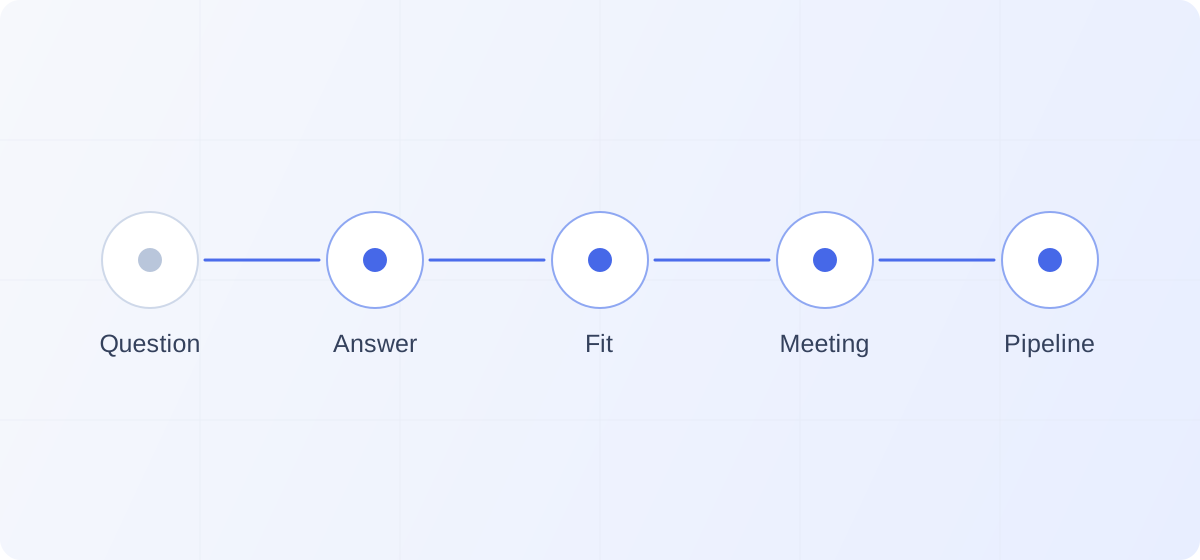
TL;DR: An inbound AI SDR talks with prospects evaluating a B2B company on its website, answering what holds them back, learning their needs, and qualifying or disqualifying fit. Qualified prospects can take the right next step, often a sales meeting, with that context passed to sales. Judge her ultimately on qualified pipeline, not conversation volume.
An inbound AI SDR is an AI sales development representative that works directly on a B2B company’s website.
She talks with prospects while they are actively evaluating the company, answers the questions holding them back, understands what they are looking for, qualifies or disqualifies fit, and helps qualified prospects take the right next step.
Her job is not to create website traffic.
Her job is to convert more of the intent already on the website into qualified pipeline.
That distinction matters.
Most B2B websites are very good at presenting information. They have product pages, pricing pages, customer stories, integration pages, security documentation, and a demo form waiting somewhere at the end.
But the experience is still fundamentally passive.
The prospect has to do almost all of the work.
They have to find the right page. Interpret what they are reading. Decide whether the product applies to their use case. Resolve any uncertainty. Decide whether they are ready to talk to sales. Then raise their hand.
The prospects who make it through that process become visible.
The ones who leave do not.
An AI SDR changes that.
The website already has intent. The problem is what happens to it.
When a prospect visits a B2B website, there is usually a reason.
Maybe they heard about the company from a colleague.
Maybe they found an article through Google.
Maybe they saw a LinkedIn post.
Maybe an outbound rep contacted them last month and they finally decided to look.
Maybe they are comparing three vendors before an internal meeting tomorrow.
Whatever brought them there, the company has already earned some degree of attention.
That attention is valuable because it is temporary.
A prospect might spend five minutes evaluating a product today and completely forget about it tomorrow. A question left unanswered can become a reason to keep looking elsewhere. A confusing pricing page can end the evaluation. A security concern can stop someone before they ever request a demo.
The traditional website waits.
An AI SDR does not.
She gives the prospect someone to talk to while that interest still exists.
So what does an AI SDR actually do?
The easiest way to understand the role is to follow a prospect through a website visit.
1. She meets the prospect while intent is live
The first job is availability.
A prospect should not have to submit a form before the company becomes responsive.
If someone is already spending time evaluating the product, an AI SDR can make a conversation available immediately.
That does not mean interrupting every visitor with an aggressive pop-up.
It means giving someone who has a real question an obvious way to get help without leaving the website, waiting for a response, or beginning a sales process before they are ready.
The timing is important.
Once the prospect leaves, the company may never get another opportunity to speak with them.
2. She answers what is holding the prospect back
Most serious B2B purchases create questions.
Does this integrate with our CRM?
Can we deploy this across multiple business units?
How long does implementation take?
Does this work for our use case?
What happens with our data?
Do you support our existing workflow?
How is pricing structured?
A prospect can search the website for every answer.
Or they can ask.
A good AI SDR should be able to understand the question, find the relevant company knowledge, give a clear answer, and continue the conversation naturally.
This is where the quality of the interaction matters.
The goal is not to produce the longest possible answer.
It is to give the prospect enough useful information to move forward.
Sometimes that is one sentence.
Sometimes the question deserves more depth.
Good sales judgment includes knowing the difference.
3. She understands what the prospect is trying to accomplish
A useful sales conversation does more than answer questions.
It creates context.
Consider two prospects asking:
“Does this integrate with Salesforce?”
The words are identical.
The situations may be completely different.
One might be a five-person startup casually researching products for next year.
The other might lead revenue operations at a 500-person company replacing an incumbent this quarter.
Answering the integration question is useful.
Understanding why the question matters is much more useful.
An AI SDR should be able to learn, naturally through the conversation, things such as:
-
what company the prospect represents
-
what they are trying to accomplish
-
what problem brought them to the website
-
how they handle the problem today
-
how urgent the problem is
-
whether the company fits the vendor’s ideal customer profile
This should not feel like a form disguised as a conversation.
Nobody wants to answer seven qualification questions in succession because a CRM needs seven fields populated.
The best conversations create value first and collect context as it becomes relevant.
4. She qualifies, and sometimes disqualifies
Qualification is not simply collecting information.
It is deciding what should happen next.
A prospect may have strong intent but be a poor fit.
Another may ask only two questions but clearly represent exactly the kind of company the sales team wants to meet.
An AI SDR should apply the company’s qualification criteria to the context of the conversation and make an appropriate decision.
That can mean identifying:
-
company fit
-
relevant use case
-
problem severity
-
commercial intent
-
urgency
-
appropriate next step
And sometimes the correct next step is not a sales meeting.
That matters.
Sending every website visitor to an account executive does not create qualified pipeline. It creates calendar volume.
A useful AI SDR protects the sales team’s time as much as she creates opportunities for it.
5. She moves qualified prospects forward
When the prospect is a fit and wants to continue, there should not be another unnecessary layer of friction.
The conversation has already happened.
The context has already been established.
The prospect should be able to move directly into the next appropriate step.
For many B2B companies, that means booking a meeting with the sales team without leaving the conversation.
More sophisticated organizations may have different routing rules based on geography, company size, product line, account ownership, or other factors.
The principle is the same:
Once a qualified prospect is ready to move forward, make moving forward easy.
6. She preserves the context for the sales team
One of the stranger parts of the traditional inbound experience is how often the prospect has to start over.
They explain something in a form.
Then an SDR researches them.
Then the SDR asks questions.
Then an account executive asks many of the same questions again.
Information exists at each stage, but the buyer experiences the company as if each interaction began from zero.
An AI SDR should preserve the context she has already learned.
The sales team should be able to see:
-
who the prospect is
-
what they asked
-
what problem they described
-
relevant qualification information
-
what was answered
-
what remains unresolved
-
what next step was recommended
When the meeting begins, the salesperson should be able to continue the conversation rather than recreate it.
And if the same prospect returns to the website later, the experience should not feel like speaking to someone with amnesia.
7. She turns conversations into a measurable revenue outcome
Conversation volume is not the goal.
Neither is chatbot engagement.
Neither is the number of messages sent.
The commercial question is:
Did the website generate more qualified pipeline?
That means an AI SDR should ultimately be evaluated on outcomes such as:
-
qualified prospects identified
-
qualified meetings booked
-
meeting quality
-
pipeline generated
-
conversion from website traffic into qualified opportunities
Closed-won revenue matters, of course.
But an AI SDR does not control the entire sales cycle. Once a qualified opportunity reaches an account executive, many other variables determine whether the company wins the deal.
The AI SDR’s direct responsibility is the part she can control:
turning website intent into qualified pipeline.
8. She teaches the company what prospects want to know
There is another useful byproduct of having conversations on the website.
Prospects tell you what is missing.
If five people ask the same integration question, that is information.
If enterprise prospects repeatedly ask about a security requirement that is difficult to find on the website, that is information.
If people misunderstand a particular feature, that is information.
If a question cannot be answered because the necessary knowledge does not exist, that is information too.
A well-designed AI SDR can surface those recurring gaps.
Over time, those conversations can help improve:
-
website messaging
-
product documentation
-
sales enablement
-
knowledge
-
positioning
-
qualification criteria
The website becomes more than a publishing surface.
It becomes a source of continuous market feedback.
An AI SDR is not just a chatbot with better writing
Chatbots can be useful.
A support chatbot can resolve common customer questions.
A navigation bot can help someone find the right documentation.
A basic marketing chatbot can collect contact information and send someone to a form.
Those are legitimate jobs.
But an AI SDR has a different responsibility.
The simplest distinction is this:
A chatbot is usually responsible for answering or routing. An AI SDR is responsible for progressing a commercial conversation.
That requires more than generating a correct response.
It requires judgment.
What does this prospect actually need?
How much should I say?
What should I ask next?
Is this company a fit?
Should this person speak with sales?
Is now the right moment to offer a meeting?
Should I answer another question first?
Those decisions are what make the role a sales role.
An inbound AI SDR is different from an outbound AI SDR
The term “AI sales agent” now describes a very broad range of products.
Many are designed primarily for outbound work: researching accounts, building prospect lists, drafting emails, sequencing outreach, or identifying people worth contacting.
That is a different problem.
Outbound begins with:
Who should we reach?
An inbound AI SDR on the website begins with:
Someone is already here. What should happen now?
The prospect has already shown some degree of intent by arriving.
The challenge is not finding another person to contact.
The challenge is making better use of the attention the company already earned.
Where do human salespeople fit?
An AI SDR does not eliminate the need for human salespeople.
She changes where their time begins.
Human sellers are especially valuable when the conversation becomes complex, strategic, political, or highly specific to the customer.
They negotiate.
They build relationships across buying committees.
They navigate procurement.
They understand organizational dynamics.
They make judgment calls when a deal does not fit a clean workflow.
An AI SDR should make those sellers more effective by ensuring the prospects who reach them are better informed, better understood, and more appropriately qualified.
The goal is not to remove humans from every sales interaction.
It is to stop requiring humans for work that can happen immediately and intelligently on the website.
Not every B2B website needs an AI SDR
The category is not automatically useful for every company.
If a company has almost no relevant website traffic, there may be very little intent to work.
If the product is extremely low-priced and completely self-serve, a sales conversation may add unnecessary friction.
If prospects rarely have questions before purchasing, the value may be limited.
The strongest use cases tend to appear when a B2B company has some combination of:
-
meaningful website traffic
-
a sales-led or hybrid go-to-market motion
-
enough contract value for better conversion to matter economically
-
products that create real buying questions
-
multiple use cases or customer types
-
a need to qualify prospects before involving sales
-
a meaningful cost when high-intent traffic leaves without converting
The right question is not:
“Should every website have AI?”
It is:
“Would a useful conversation at the moment of intent create more qualified pipeline for this business?”
If the answer is yes, an AI SDR becomes interesting.
The standard should be much higher than “it can answer questions”
The technology required to put an AI conversation on a website is becoming easier to access.
That means the real differentiation moves elsewhere.
A good AI SDR should be judged on things like:
Accuracy: Does she represent the company truthfully?
Conciseness: Does she know when a short answer is better than an essay?
Sales judgment: Does she know what to ask next and when?
Qualification: Does she distinguish genuine opportunities from noise?
Restraint: Does she avoid claims she cannot support?
Context: Does she understand the conversation rather than treating every message independently?
Action: Can she help the right prospect move forward immediately?
Handoff: Does the sales team receive the context it needs?
Outcome: Does any of this result in more qualified pipeline?
The ability to generate text is increasingly common.
The ability to consistently make the right commercial decision inside a real prospect conversation is much harder.
That is where the category gets interesting.
The website should be an active revenue surface
For years, most B2B websites have behaved like digital brochures with increasingly sophisticated analytics attached to them.
Visitors arrive.
Pages explain.
Forms collect.
Humans follow up later.
AI makes a different experience possible.
The website can now listen.
It can answer.
It can understand.
It can qualify.
It can act.
That does not make pages, forms, content, or human salespeople obsolete.
It gives the website something it has historically lacked:
the ability to have the conversation itself.
That is the job of an AI SDR.
At Kassie, we are building that role for B2B companies.
Kassie talks with prospects while they are on the website, answers what is holding them back, qualifies fit, and helps turn more existing website traffic into qualified pipeline.
The easiest way to understand the experience is to talk to her.
Frequently asked questions
What is an inbound AI SDR?
An inbound AI SDR is an AI sales development representative that works directly with prospects, typically through a company’s digital channels. On a B2B website, an inbound AI SDR can answer prospect questions, understand their needs, qualify or disqualify fit, and help qualified prospects move toward a sales conversation.
Is an AI SDR the same as a chatbot?
No. A chatbot is generally designed to answer questions, provide support, collect information, or route users. An AI SDR is responsible for progressing a commercial conversation toward an outcome, which requires qualification, sales judgment, and the ability to take appropriate next actions.
Does an inbound AI SDR replace a human SDR?
Not necessarily. AI SDRs and human SDRs can operate at different points in the sales process. An inbound AI SDR can handle immediate website conversations and qualification, allowing human salespeople to spend more time with prospects who need human judgment, relationship building, and deeper commercial conversations.
How does an AI SDR generate qualified pipeline?
An AI SDR engages prospects while they are actively evaluating a company, answers questions that may otherwise prevent them from moving forward, learns enough context to determine fit, and gives qualified prospects an immediate path to the sales team. The result is that more existing website intent can become visible, qualified pipeline.