
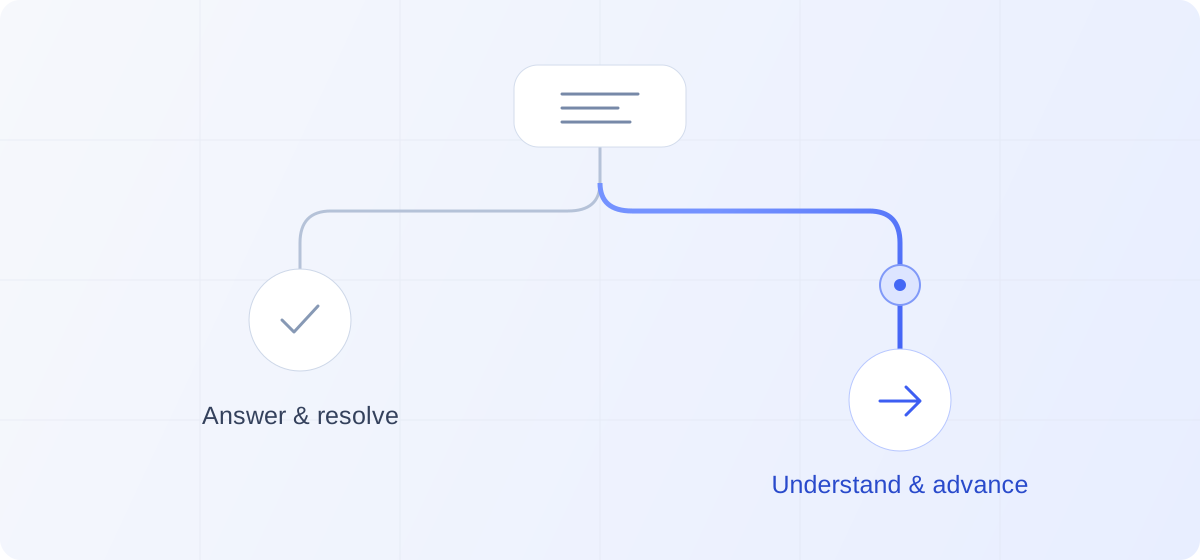
TL;DR: Inbound AI SDRs and chatbots differ by job, not label. Chatbots may answer questions, handle support, or even book meetings. An AI SDR’s job is sales: helping prospects evaluate fit, moving suitable ones toward a meeting, and giving poor fits an honest answer. For website sales, judge any system by real conversations and total qualified pipeline.
An inbound AI SDR is built to handle commercial conversations: answer prospect questions, understand their needs, qualify fit, and help suitable prospects move toward a sales meeting.
A chatbot is a broader category of conversational software. It can answer questions, support customers, collect information, and, depending on its capabilities, perform sales tasks too. The terms overlap. The useful distinction is the job the system is configured to do and the outcome you expect from it.
For a B2B website, that distinction becomes clear at a particular moment.
Your prospect asks a question.
The answer is correct.
Then what?
Does the conversation end? Does the prospect receive a link? Does someone ask for an email address? Or does the response help them understand whether your product solves the problem that brought them to your website?
A correct answer can be useful without being enough to move an evaluation forward.
That is where sales judgment begins.
The label tells you less than the conversation
It would be convenient if every chatbot followed a rigid script and every AI SDR understood prospects perfectly.
That would make this comparison easy.
It would also make it misleading.
Modern AI chatbots can understand natural language, maintain conversational context, connect to business systems, and complete tasks. Scheduling a meeting or updating a record is no longer a capability reserved for products with “agent” in their name.
Customer support has evolved too. Zendesk describes AI agents that perform actions in authorized systems and resolve issues, rather than simply return help-center articles.
The boundary between support and sales is also becoming less rigid. Intercom documents separate service and sales roles for Fin, with different goals and configuration for resolving customer issues versus qualifying prospects and guiding them toward a commercial next step.
So the purchasing question cannot be, “Does this vendor call its product a chatbot or an AI SDR?”
Ask what happens when a real prospect brings a real question.
The product’s behavior is the evidence.
The same question can lead to two different outcomes
Imagine a prospect evaluating a fictional B2B platform that allows customers to deploy one team at a time.
They ask:
“Can we start with one team before moving the rest of the company?”
An answer-focused response might be:
“Yes. You can start with one team and add others later.”
That is accurate. It may be everything the prospect needed.
A commercially useful response could go one step further:
“Yes. You can start with one team and add others later. Is your main concern testing the workflow or keeping the rollout manageable?”
Now the prospect has room to explain:
“We need to prove it works for our operations team before our current contract renews in January.”
The conversation has uncovered something that the original question did not reveal.
There is an existing product. There is a specific team. There is a decision deadline. There is a condition that must be met before the company can move forward.
The next response should use that information.
It might explain how a limited rollout works, clarify a genuine product constraint, or suggest a conversation with someone who can help plan the evaluation.
It should not immediately launch into a pitch. It should not promise migration capabilities that have not been confirmed. And it should not ask when the current contract renews, because the prospect has already said.
The value is in recognizing what the answer means for the prospect’s decision.
That is the behavior to look for in an AI SDR.
Compare the responsibility behind the interface
A support conversation and a sales conversation can use similar technology while serving different purposes.
This is a more useful comparison than a checklist claiming one category has features the other lacks:
| Dimension | Question-answering or support role | Website sales role |
|---|---|---|
| Primary responsibility | Help someone find information or resolve an issue | Help a prospect evaluate fit and move toward an appropriate commercial next step |
| Context that matters | The request, account, product state, and troubleshooting history | The prospect’s problem, use case, company fit, constraints, and readiness |
| Follow-up questions | Clarify what is needed to resolve the request | Clarify what matters to the purchasing decision |
| Successful completion | The person gets the answer, resolution, or support handoff they need | A suitable prospect progresses, or a poor-fit prospect receives an honest answer |
| Human handoff | Transfer unresolved or sensitive issues with useful context | Connect qualified prospects with the relevant sales representative and preserve the conversation |
| Business evaluation | Resolution quality, customer satisfaction, and service efficiency | Qualification quality, meetings held, and incremental pipeline |
These are different assignments, not a ranking of intelligence.
A technically sophisticated support agent can be excellent at resolving a difficult customer issue. A sales-focused agent can be excellent at helping a prospect decide whether the product deserves further evaluation.
The question is whether the system understands which job it is doing.
Sales judgment shows up in the small decisions
It is easy to be impressed by an articulate answer.
The more revealing moments come afterward.
Does the conversation respect the prospect’s pace?
Consider someone who says:
“We’ve already evaluated the product. I need to speak with someone about an enterprise agreement.”
A poor experience makes them sit through the standard introduction, answer questions they have already resolved, and explain why they are interested.
An effective AI SDR should recognize how far along they are. Gather whatever information is genuinely necessary to connect them appropriately, then help them proceed.
Now consider someone who says:
“I’m researching options for next year. Can you explain how your pricing works?”
They need a clear pricing explanation. They do not need a meeting request attached to every response.
Both prospects deserve help. They need different help.
Does qualification build on what has already been said?
An email address makes someone contactable. A completed set of fields makes a record more complete.
Neither, by itself, establishes whether a sales conversation is worthwhile.
If a prospect explains that a particular integration is essential and your product does not support it, the AI SDR should address that limitation before asking about their budget.
If the prospect has already explained the use case, there is no value in asking them to select it again from a menu.
Qualification should help both sides determine fit. It should not feel like an administrative toll collected before the prospect can get an answer.
Can the AI SDR recognize when a meeting would be wrong?
Suppose a prospect says:
“This looks useful, but we need it to run entirely on our own servers.”
Your product does not offer that deployment model.
The commercially responsible answer is to explain the limitation. It may be worth clarifying whether the requirement is essential, but it is not acceptable to imply the capability exists to keep the conversation moving.
A meeting booked through a misleading promise is not a win.
The same applies when the visitor is a job seeker, an existing customer seeking support, or someone whose requirements fall outside the product’s scope.
Good qualification includes knowing when to stop selling.
A better sales conversation should not break customer support
Replacing a website chatbot is not always a simple upgrade.
Before changing anything, establish what the existing experience does.
Perhaps customers use it to reach support. Perhaps a self-serve product depends on it to resolve setup problems. Perhaps prospects use it occasionally, but its primary job is helping people who already pay you.
Removing that path without a replacement can create a new problem while attempting to solve another.
For a B2B company with both prospects and customers on the website, the requirements should be explicit.
Prospects need help understanding fit and taking a commercial next step. Customers need access to the support they came for. Neither group should have to navigate the wrong conversation.
That does not necessarily require one vendor to do everything. It does require a deliberate handoff.
An AI SDR can operate on selected commercial pages while an existing support experience remains elsewhere. Another configuration might identify support requests and direct customers to a clearly established support channel.
The right arrangement depends on the product and the website’s existing journeys.
Do not force a customer with a service problem through a sales conversation. And do not remove a working demo form simply to make a new conversational experience unavoidable.
An AI SDR should earn her place by improving outcomes.
More conversations are not automatically more pipeline
Imagine your website introduces a new conversational experience.
Engagement rises. More visitors send messages. The dashboard shows more meetings attributed to the new interface.
Has the website become a better revenue channel?
Possibly.
But some prospects may have used the conversation instead of the demo form. Some meetings may not happen. Some may involve companies your team would not pursue.
The measurement needs to account for those possibilities.
A useful evaluation follows the conversation beyond the booking confirmation:
Did the prospect meet your qualification criteria? Did the meeting happen? Did your team accept a genuine opportunity? Did total website-generated pipeline improve?
A booked meeting and a sales opportunity should remain distinct in your reporting.
For example, suppose the website previously produced 20 qualified meetings a month through its form. After adding an AI SDR, the form produces 12 and the conversation produces eight.
The new interface participated in eight meetings. The website still produced 20 overall.
There may be other benefits, such as less manual qualification or better context. But the meeting count alone does not demonstrate incremental growth.
This is why the evaluation should include both the conversational experience and the website’s total results.
Where traffic volume allows, compare similar groups of visitors through a controlled test. Where it does not, use a baseline and account for changes in campaigns, traffic quality, seasonality, and the website itself.
The standard is more qualified pipeline from the website, not more credit assigned to the chat interface.
Test the decisions, not just the answers
A product demo should help you understand whether the experience deserves to represent your business.
Use questions your prospects actually ask. Then change the situation and see whether the response changes appropriately.
Start with a prospect who is ready to meet. Does the system help them move forward, or delay them with unnecessary discovery?
Try a prospect whose requirements do not fit. Does it acknowledge the limitation, or keep pushing toward a meeting?
Ask a question that your approved materials do not answer. Does it express uncertainty and provide an appropriate next step, or invent a reassuring response?
Arrive as an existing customer with a support problem. Does it recognize the request and preserve access to help?
These tests reveal more than asking a series of easy product questions.
Both chatbots and AI SDRs need reliable information, appropriate access controls, ongoing evaluation, and human escalation. An agent label does not eliminate the risk of inaccurate or misleading answers.
A tailored demo can demonstrate conversation quality and expose obvious weaknesses. It cannot, by itself, establish how much additional pipeline the product will generate from your actual traffic.
That evidence comes from deployment.
Which approach does your website need?
Start with the work that is currently underserved.
If your main problem is customers struggling to get support, evaluate the quality of resolution and escalation.
If prospects can buy easily without a conversation, preserve that path. Adding dialogue should help people who need it, not slow down everyone else.
If relevant prospects arrive with questions about fit, implementation, integrations, or commercial terms, there may be a valuable role for an AI SDR. That role becomes more compelling when the company has meaningful deal values, identifiable qualification criteria, and an opportunity to improve how website interest becomes pipeline.
And if your existing chatbot already performs that sales work well, evaluate the evidence before replacing it.
A different name is not a business case.
A better result is.
Frequently asked questions
Can a chatbot qualify prospects and book meetings?
Yes. Some AI chatbots support qualification, scheduling, and connections to business systems. Evaluate how well those capabilities work together in your sales process rather than assuming they are absent because the product is called a chatbot.
Does an AI SDR need to replace our support chatbot?
No. Sales and support experiences can coexist, provided visitors have clear paths and requests reach the appropriate destination. The deployment should preserve support access while improving the commercial experience.
Is an AI SDR always better for website conversion?
No. The benefit depends on your traffic, prospects’ questions, existing conversion paths, and the quality of the implementation. Measure whether the experience produces additional qualified opportunities without adding friction or damaging another working journey.
Give the conversation a commercial purpose
At Kassie, we focus on the website prospect conversation: understanding what someone needs, answering the questions holding them back, qualifying fit, and helping qualified prospects book with the sales team. Kassie’s product is built around approved business knowledge, qualification criteria, and meeting booking inside the conversation.
The ambition is straightforward: generate more qualified pipeline from traffic you already have.
That requires more than fluent writing. It requires knowing when to answer, when to ask, when to help someone book, and when to acknowledge that the fit is not there.
Your prospects should leave the conversation with a clearer understanding of whether your business can help them. Your team should receive opportunities it has a reason to pursue.
That is the standard an AI SDR should meet.