
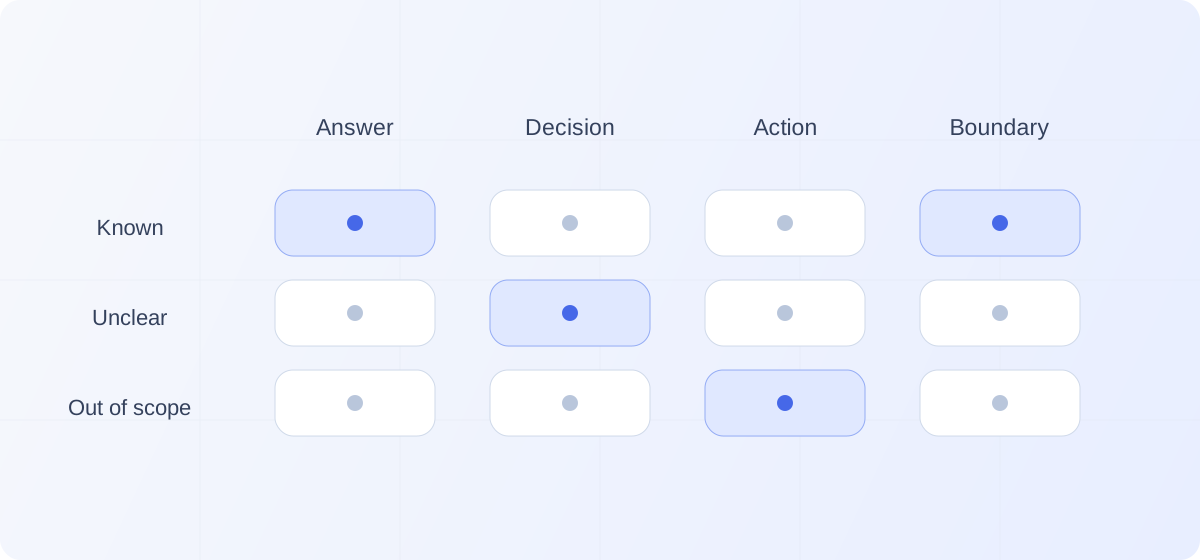
TL;DR: Test an inbound AI SDR on your own prospect situations, not just vendor-chosen questions. Check that answers don’t mislead, decisions follow your qualification policy, and claimed bookings or CRM updates completed correctly. One critical failure outweighs many correct answers. Confirm your team can inspect, change, and pause her. Tailored demos show capability; measure ROI after launch.
An inbound AI SDR will answer questions under your company’s name.
A prospect who receives an inaccurate explanation will not distinguish between your business and the software representing it. The answer becomes part of their understanding of what you offer.
That makes evaluation more important than choosing the most impressive demonstration.
To evaluate an AI SDR, test how she handles realistic prospect situations using your approved product information and qualification criteria. Examine the answers, the decisions, and the actions that follow. Then establish what your team can inspect, change, and stop after deployment.
A polished conversation is a useful starting point.
The decision is whether you would trust the same experience with your actual prospects.
Start with the assignment
Before comparing vendors, write down the work you need done.
Perhaps prospects reach your pricing page with questions about which plan fits their situation. Perhaps your team spends too much time qualifying demo requests. Perhaps relevant visitors need help understanding a technical product before they are ready to meet.
Choose the problem you can describe most clearly.
Then define a successful interaction.
For example:
“A prospect should be able to understand whether we support their use case, receive accurate answers to their questions, and book with the appropriate representative when there is enough fit to continue.”
That statement gives you something to evaluate.
“Have better AI on the website” does not.
Include the boundaries, too. Which questions require a specialist? Which product limitations must be made explicit? What should happen when an existing customer requests support?
Your evaluation should reflect the job you will actually assign, including the situations where the right response is to involve a person.
Bring the prospect situations that matter
Do not let the entire evaluation consist of questions selected by the vendor.
Build a small set from your own business.
Use the questions that repeatedly appear in discovery calls. Include requirements that have disqualified otherwise promising prospects. Add examples where someone already understood the product and wanted to move quickly.
Remove personal or confidential information unless you have an appropriate basis and approved environment for sharing it.
For each situation, write down what a satisfactory outcome would look like before running the test.
| Prospect situation | What you should look for |
|---|---|
| A relevant prospect asks a specific product question | An accurate answer with the context needed to understand it |
| A prospect has a mandatory requirement you cannot meet | A clear explanation of the limitation |
| An evaluator does not yet know the budget | A decision consistent with your qualification policy, rather than an invented conclusion |
| A qualified prospect is ready to meet | A direct path to scheduling without unnecessary repetition |
| Someone asks a question your materials do not answer | An honest acknowledgment and an appropriate next step |
| An existing customer needs support | Recognition of the request and access to the established support path |
This is not a script the prospect must follow word for word. It is a set of situations the product must handle responsibly.
Intercom’s documentation for sales-agent simulations makes a useful distinction between testing what the agent says, where it routes the lead, what information it collects, and whether an expected action occurs. Those are separate dimensions of performance.
Use that same separation when evaluating any product.
Read the answer in the context of the decision
An answer can be factually correct and still leave the prospect with the wrong impression.
Imagine a fictional analytics platform that supports Salesforce through a nightly data import. A prospect asks:
“Will this update Salesforce as our team works?”
The answer “We integrate with Salesforce” is true but insufficient.
The prospect is asking about direction and timing. They need to know what the integration actually does.
Your evaluation should examine whether the AI SDR recognizes the distinction and explains the limitation without burying it.
Then continue the conversation.
Suppose the prospect says:
“Nightly would be too slow. We need updates immediately.”
Does the response preserve that requirement? Does it acknowledge the mismatch? Or does it return to a broad description of integration capabilities?
This is where a realistic exchange reveals more than a collection of isolated questions.
You are evaluating whether the product understands what its answer means for the prospect’s situation.
The same principle applies to pricing, implementation, security, and qualification. A reassuring sentence should not replace the specific information needed to make a decision.
Follow “done” into the connected system
When an AI SDR says a meeting is booked, verify the booking.
When a vendor demonstrates CRM handoff, inspect the resulting record.
The visible conversation is only one part of the workflow.
Use an approved test environment or clearly identified test records. Confirm which actions will affect real calendars or production systems before running them.
Then inspect the details.
Was the meeting assigned to the intended representative? Was the time zone correct? Did the confirmation reach the test participant? Did the CRM receive the information promised? Was an existing record updated appropriately?
Test a failure as well.
An unavailable calendar should not produce a fictional confirmation. A rejected CRM update should not be described as successfully completed. The prospect needs an accurate explanation, and the team needs a way to recover.
Testing environments themselves have limits. Intercom documents that Fin for Sales simulations stop at the routing decision: the scheduling link and inline calendar steps do not execute. It recommends a live Messenger conversation to verify those steps. Passing a simulated workflow is therefore different from verifying the actual integration.
Ask what the demonstration proves and what remains to be tested.
A convincing interface is not a substitute for a completed action.
Check what the AI SDR is allowed to access
A website conversation does not need unrestricted access to your business.
Establish which information the system can retrieve, which records it can change, and under what conditions those actions are permitted.
Someone stating an email address should not automatically gain access to the private account history associated with it. A publicly accessible conversation should not reveal internal pricing exceptions or another customer’s information.
These boundaries need technical enforcement, not merely instructions asking the model to behave.
OWASP identifies excessive functionality, permissions, and autonomy as sources of risk in AI systems that can act through connected services. Its guidance includes restricting permissions to the work required and using human approval where appropriate for consequential actions.
You do not need to become a security engineer to ask useful questions.
What data reaches the model? What remains private? How is account access verified? Who can approve changes? What happens when a visitor asks the system to ignore its rules?
Involve the people responsible for security and data handling in your organization. Their role is to establish whether the deployment is acceptable, not to infer safety from an articulate response.
Separate a content gap from a fundamental failure
Not every unsuccessful test should produce the same decision.
An outdated implementation document may be straightforward to correct. A qualification question may need better wording. A missing calendar connection may need configuration.
Other failures deserve a different response.
Disclosing private information, inventing a material product capability, or repeatedly claiming that unsuccessful actions completed should not disappear inside a favorable average score.
Correctly answering 99 routine questions does not compensate for mishandling one critical boundary.
Record what failed, what caused it, and what evidence would demonstrate that the correction worked.
Then repeat the relevant scenarios.
Do not require identical wording across runs. Require consistent decisions, accurate claims, and appropriate actions.
Your final decision should make the unresolved issues visible. “Ready for the proposed scope” is a much more useful conclusion than “the demo was impressive.”
Ask what happens when your business changes
The evaluation should include the operating experience after launch.
Your pricing will change. A product limitation may disappear. A new limitation may emerge. Qualification criteria may need adjusting as the team learns which prospects become successful customers.
Who makes those updates?
Can the team see which information informed an answer? Can changes be reviewed before publication? Can a problematic response be traced back to its source? Can the experience be paused without disabling the rest of the website?
Intercom’s batch-testing documentation illustrates one useful operational pattern: reusable question groups can be tested against content and configuration changes before those responses reach customers.
The broader requirement is simple: improvements should be repeatable.
A product that behaves well only while the vendor’s expert is supervising the demo may be difficult to operate once that person leaves.
Understand the customer’s responsibilities, the vendor’s responsibilities, and the expected effort on both sides.
Keep demonstrated capability separate from demonstrated ROI
A tailored demo can show how an AI SDR represents your product.
It can reveal weak answers, poor judgment, unnecessary qualification, and broken actions. It can also establish that the experience is substantially better than what you offer today.
It cannot establish how many additional opportunities your actual website traffic will produce.
That requires operational evidence.
Keep those questions separate when making the purchase decision. You may have enough confidence to deploy before you have a complete return-on-investment history. Be explicit about the assumptions, the scope, and how results will be reviewed.
There is no universal requirement that every purchase follow the same pilot process.
There is a requirement to understand which risks have been tested and which remain.
Frequently asked questions
Should we test an AI SDR on our own product information?
Yes. Your information exposes the requirements and boundaries that matter to your business. A vendor’s generic demo can demonstrate the interface, but a business-specific evaluation shows how the system handles your actual product and qualification decisions.
How many test conversations are enough?
There is no universal number. Cover the important use cases, meaningful variations, and critical failure conditions. A small, well-chosen set is a starting point, not proof that every possible conversation will work.
Does a successful demo prove the product will generate pipeline?
It demonstrates capability under the conditions tested. Incremental pipeline depends on your traffic, prospect needs, deployment, and subsequent sales process. Establish how those outcomes will be measured after launch.
Choose the experience you would put your name on
Kassie is built around answering prospect questions from approved business knowledge, applying qualification criteria, and helping qualified prospects book with the sales team.
Those capabilities should be experienced, inspected, and evaluated against the work your website needs done.
Bring your real questions. Bring the awkward cases. Ask what happens when the answer is unknown.
The best evaluation leaves you with more than enthusiasm.
It leaves you with a clear understanding of what the product can do, where its limits are, and why you trust it to represent your business.