
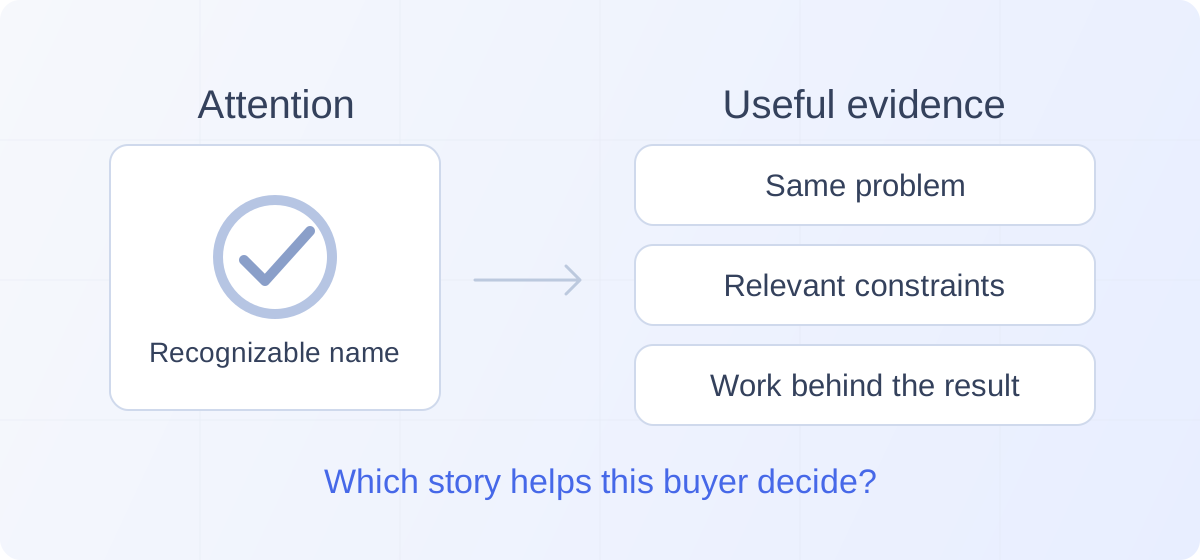
Open the customer story your sales team sends most often. Cover the logo. Would you still know which buyer should read it?
A recognizable name gives someone a reason to look. To choose the story that helps them decide, match the customer's original problem, operating constraints and path to the result with the buyer's situation. Company size and industry help narrow the search. The question the buyer needs answered should settle it.
That changes which stories marketing commissions, how it writes them and what sales sends next.
Match the difficulty, not just the industry
Suppose you sell reporting software. Your most prominent customer has a dedicated analytics team and a story about consolidating dozens of dashboards. A prospect with one operations manager asks whether they can stop building a weekly report by hand.
Both companies need reporting. They face different difficulties.
The prospect needs to know who configured the system, how messy the source data was, and whether someone without an analytics team can keep it running. A smaller customer's account of that work could be more useful than the famous company's largest number.
Ask the rep what the buyer is trying to establish before choosing the attachment. “They want to see customers in their industry” is a starting point. “They need to know whether their operations manager can own this without hiring” gives you a reason to select one story over another.
Organize the library around those questions. Keep industry and company-size filters, but add the problem, the constraint and the work required. A rep should be able to find a story about a difficult migration as easily as one about a financial-services company.
Interview for the part the headline leaves out
A customer saying they saved time leaves the next buyer with some reconstruction to do. Whose time? Doing what? What did they have to change first?
In the next customer interview, stay with one task. Ask the person to describe the last time they did it the old way. Then walk through the first time they completed it with your product. Find out who helped, what failed, what they kept using and what still requires a person.
The answers make the story useful even when the headline result is modest. They also tell you whether a result depended on something a new buyer would need to provide: a cleaned database, an internal administrator, a services engagement or a change in process.
Keep those conditions next to the outcome. If the customer estimated the time saving, say so. If the measurement covers one department, keep that scope visible. The buyer needs enough detail to judge whether the result could transfer to their company.
For the customer, this can be a better story too. It gives their team credit for the decisions and effort behind the improvement.
Give the proof a specific job
Before sending a case study, finish this sentence: “This should help you decide whether…”
Then point to the relevant passage. If the buyer is concerned about administration, send the section explaining what the customer owns after launch. If they are questioning the economics, send the measured result with its scope and costs. An entire resource library is a lot of homework for someone who asked one question.
Use the same discipline on the website. Put proof beside the claim it supports. A story about faster reporting belongs near the reporting workflow; it cannot substantiate every promise elsewhere on the page. Our guide to helping buying groups evaluate takes that further: evidence needs to remain understandable when the first reader forwards it to a colleague.
The next time sales asks for more case studies, ask for three live buyer questions the current library cannot answer. You may already have a customer whose experience resolves one of them. They may never have made the shortlist for a homepage logo.
That is a good reason to call them.