
A prospect likes what they see. They understand the product and can explain how their team would use it.
Then they send a message to a colleague:
“I found something worth looking at.”
What happens next can determine whether the evaluation moves forward.
The colleague may ask who would run it, what it replaces, which systems it needs, or whether the potential improvement is worth another purchase.
Your prospect now has to answer questions that were not necessarily part of their own research.
If all they have is an enthusiastic impression and a homepage link, they must reconstruct the case themselves.
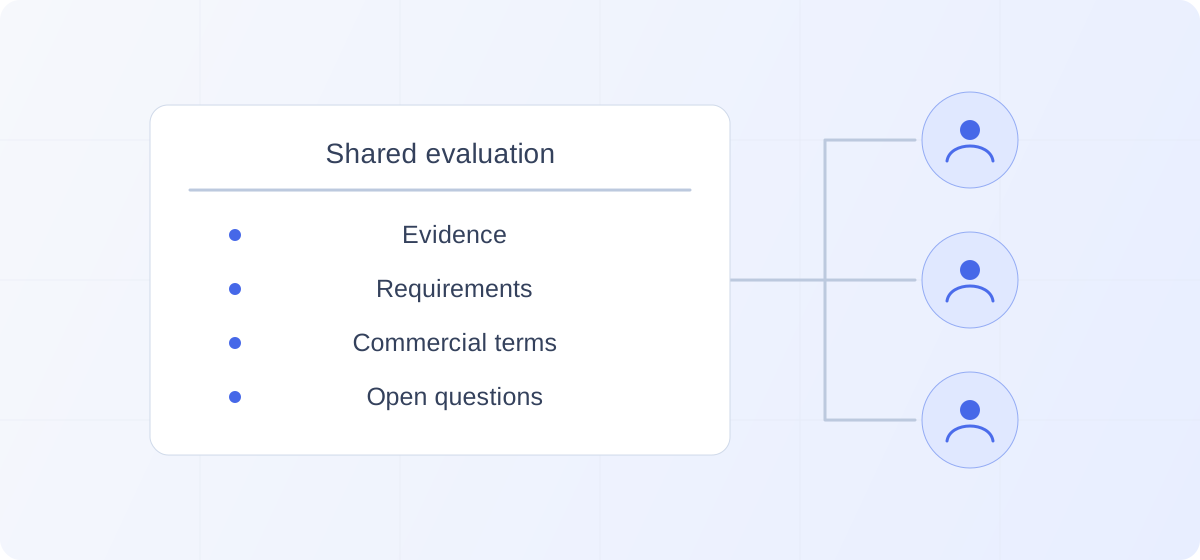
A useful B2B website should help prospects carry an evaluation into their own organization. That means making the product’s fit, requirements, costs, evidence, and limitations understandable to people who were not part of the original conversation.
A good website answer should remain useful after it is forwarded.
The person who understands the product may not be the person who approves it
Consider a fictional customer-success leader evaluating an onboarding platform.
They want to replace the spreadsheets used to track new customer implementations. They have seen enough to believe the product could help.
Their operations colleague has a different concern: someone will have to configure the workflows and keep them current.
The finance team wants to understand the subscription, implementation work, and whether an existing expense will actually disappear.
The person reviewing system access wants to know which customer information the product needs and what it can change.
These are not three objections to the same sales pitch. They are three parts of evaluating the same purchase.
Edelman and LinkedIn’s 2025 research highlights the role of less visible stakeholders who influence purchases without necessarily participating in the vendor’s main sales conversations. Its findings draw on nearly 2,000 global professionals, including visible and less visible decision-makers.
The website cannot negotiate every internal priority. It can prevent the interested prospect from becoming the sole interpreter of the product.
Make the information available in a form another person can inspect.
That serves a different need from persuading the original visitor to click a button.
Give the group one purchase to evaluate
Personalization can go wrong when each person receives a different version of what the product is supposed to accomplish.
Imagine the onboarding platform tells customer success it will remove administrative work. It tells operations it offers unlimited customization. It tells finance no additional resources are needed.
Those statements could be difficult to reconcile. Customization may require someone to design, approve, and maintain it.
A coherent explanation makes the tradeoff visible.
“The platform replaces the shared tracking spreadsheet and automates agreed reminders. Your team still owns the onboarding process, and an administrator will need to configure changes.”
Now the different stakeholders can evaluate the same proposal.
Gartner’s survey of 632 B2B buyers, conducted in August and September 2024, found that groups reaching consensus were 2.5 times more likely to report a high-quality deal. Its analysis also warned that content narrowly tailored to individual priorities can reinforce disagreement rather than help the group align. Those are reported associations, not a guarantee that a particular content format improves conversion.
Our recommendation is to adapt the explanation without changing the underlying facts.
The finance reader may need more detail about cost. The operational reader may need more detail about ownership. They should still be evaluating the same scope, limitations, and intended result.
Relevance should help colleagues understand the proposal from different angles. It should not give each person a different promise.
Publish information someone can reuse
A homepage is useful for orientation. An internal evaluation needs more specific material.
Nielsen Norman Group’s foundational B2B usability research identified this distinction: researching, approving, purchasing, and using a product can involve different people, and websites need to support those different information needs. The research is historical, not a current market benchmark, but the design problem is directly relevant here.
For each important product claim, make it possible to find and share the supporting explanation.
A prospect should be able to point a colleague toward a specific integration description, implementation requirement, pricing explanation, or relevant product example.
Use stable pages and descriptive headings. Make important qualifications visible beside the claim they limit.
A document saying “implementation is simple” gives an internal reviewer little to work with.
A page explaining what access is needed, which tasks the customer owns, and what determines the timeline is more useful.
Some material may require an authorized review process before sharing. That is reasonable. Explain how to obtain it rather than leaving the prospect to guess whether it exists.
The goal is to reduce reconstruction work.
Your prospect should not have to take screenshots of six pages, interpret inconsistent terminology, and write the missing explanation themselves.
Build a short decision brief around the actual evaluation
A useful internal summary does not need to be a pitch deck.
For a serious evaluation, offer a concise explanation of what has been established and what remains open. This can be assembled by a representative from approved information; it does not require a new software feature.
The structure should answer five questions.
What are we trying to improve?
Describe the customer’s problem in language they recognize.
For the fictional onboarding platform, that might be keeping implementation owners and customers aligned on outstanding tasks.
Do not substitute the vendor’s category slogan for the customer’s actual situation.
What would change?
Explain the specific work the product would perform and what remains with the customer.
This is where a vague promise becomes an operating proposal.
If the product automates reminders but does not design the onboarding process, say so. If it provides visibility without replacing the CRM, make that clear.
What evidence supports the fit?
Link to the product behavior, documentation, or relevant customer evidence that supports the proposed use.
Distinguish a capability demonstrated in a test from an outcome achieved in a live deployment. A customer story can be useful, but its results do not automatically predict another customer’s performance.
Keep important conditions attached to the evidence.
What would it cost and require?
Include the applicable commercial terms, implementation responsibilities, and dependencies.
Separate a public starting price from a quote for the prospect’s configuration. Distinguish recurring fees from one-time work.
Where something is not yet known, mark it as unresolved.
A precise unknown is more useful than a reassuring estimate that nobody owns.
What decision are we asking for now?
An internal conversation may concern permission to investigate, approval for a technical review, or a purchase.
Do not turn an exploratory discussion into a final approval request simply because the vendor wants to move quickly.
Make the immediate decision proportionate to the evidence available.
For the fictional onboarding evaluation, a short brief could read:
Purpose: Evaluate replacing the spreadsheets used to coordinate customer onboarding.
Proposed change: Track owners, milestones, and agreed reminders in one system. Our team would still own the onboarding process.
What is established: The published product supports milestone tracking and automated reminders. We have reviewed the relevant workflow demonstration.
What remains open: Required CRM access, configuration effort, the commercial scope, and who would administer the deployment.
Decision now: Whether to arrange a focused review with operations to resolve those questions before considering a purchase.
This is less promotional than a list of superlatives. It is also something a colleague can respond to.
Keep uncertainty in the material you share
An internal summary should not become more confident than the conversation it summarizes.
If a prospect said a project might begin next quarter, do not write that the company has committed to a deployment date.
If an integration requirement still needs confirmation, do not label it supported because the product has a logo for that system.
If an economic calculation depends on an assumed conversion rate, keep the assumption attached.
The people receiving the summary need to distinguish established facts from the next questions.
This matters even when the uncertainty makes the deal look less advanced.
A clean explanation of an unresolved issue can lead to a useful technical discussion. An overconfident explanation can create an internal commitment the product cannot fulfill.
The best material makes it easier for the group to challenge the proposal intelligently.
It should help them say yes for defensible reasons or identify a genuine reason not to proceed.
Do not appoint a champion who has only expressed interest
Someone saying “this looks useful” has not agreed to sell it internally.
They may be doing initial research. They may be willing to share information but not lead an evaluation. They may not know who needs to participate yet.
Ask what would help them take the next step.
“What would your team need to understand before deciding whether this is worth evaluating?”
That question reveals the work ahead without assigning the prospect a role they have not accepted.
Offer relevant information or a focused conversation with the appropriate specialist. Let the prospect decide what is useful.
Avoid turning every request for information into a demand to bring their boss to a meeting. Likewise, do not insist that every stakeholder speak with sales before accessing basic product facts.
Some colleagues need to participate directly. Others need a clear explanation and a trustworthy source.
Your job is to make the evaluation easier, not maximize the number of people in a calendar invitation.
A website AI Rep should create clarity that carries forward
A useful prospect conversation can clarify the problem, identify relevant requirements, and expose questions that need further work.
Its value should remain visible after the interaction ends.
For an AI Rep, that means representing the product consistently and distinguishing what the prospect said from what the system inferred. Any handoff should preserve the unresolved issues, not merely report that someone appeared enthusiastic.
Kassie’s current website describes qualification using approved knowledge and the prospect’s answers, with conversation context carried into configured revenue workflows.
That is part of helping the next conversation begin from a more informed position.
It does not mean a website agent should know everything another employee at the same company has discussed.
Do not expose a colleague’s private conversation because someone supplies a matching company domain. Do not assume that everyone researching the same vendor belongs to the same evaluation.
Help prospects share the information they choose to share. Keep public product evidence distinct from private account and conversation details.
The goal is continuity with permission, not invisible surveillance of a buying group.
Test the material with someone who missed the conversation
There is a simple way to assess whether your website and follow-up material support internal evaluation.
Give the relevant pages and a short summary to someone who was not part of the original discussion. Ask them to explain what the product would change, what the organization would need to do, and which uncertainties remain.
This is a proposed usability exercise, not a validated scoring system.
The answers will expose gaps.
If they can repeat the tagline but cannot explain the operating change, the material is still too promotional.
If they believe a conditional capability is universally available, the qualification is too easy to miss.
If they think the next step is a purchase when the request was only for a technical review, the decision has not been framed clearly.
You can run the exercise with a trusted colleague first. Feedback from actual evaluators will become more useful as customer relationships develop.
The question is not whether they liked the writing.
It is whether they understood the proposed decision accurately.
Look for progress in the evaluation, not document activity
A forwarded page or downloaded brief is not automatically a buying signal.
The more useful evidence is whether the material helps someone resolve a real issue.
Did operations understand the implementation requirement? Did the relevant technical person join because there was a specific question to answer? Did finance receive a clear commercial scope? Did the group identify a disqualifier before investing more time?
These are meaningful developments even when they do not all lead to a sale.
Review the questions that still come back. Improve the material where explanations repeatedly fail.
Do not claim that every shared document accelerated the deal. Its contribution may be difficult to isolate, and internal priorities remain outside your control.
The purpose is to remove avoidable work from a legitimate evaluation.
Help the decision survive beyond the first conversation
Your website does not have to close the deal on behalf of an entire organization.
It should leave the interested person better equipped to involve the people who matter.
That requires clear product facts, honest limitations, usable evidence, and an understandable next step.
An impressive conversation earns attention. Information that colleagues can inspect helps that attention become a serious evaluation.
The strongest answer is one your prospect can take back to the team without having to rewrite, qualify, or defend it alone.