
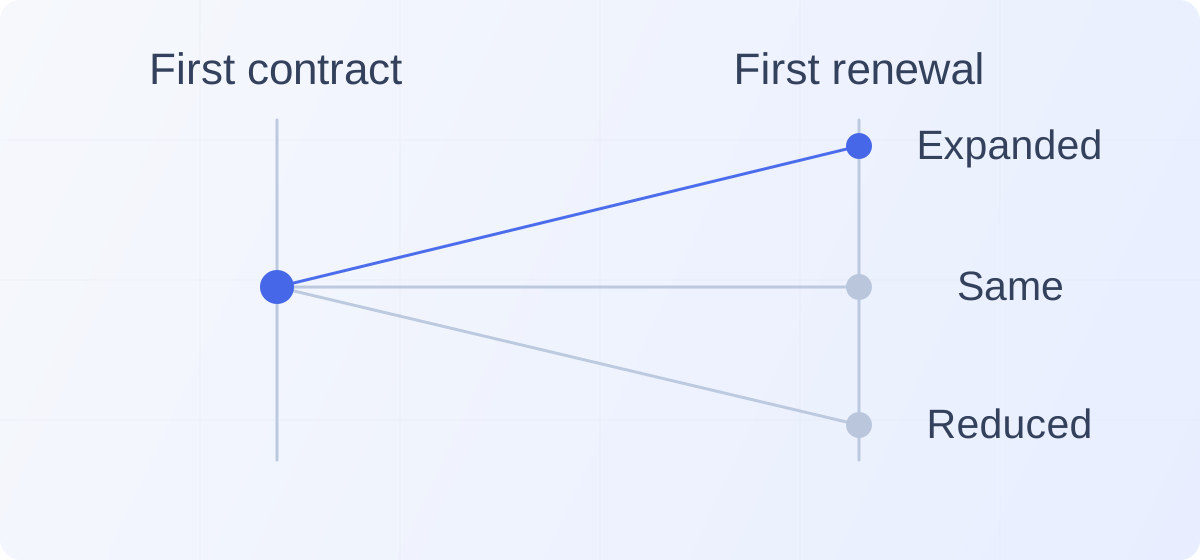
Before you spend next quarter’s budget finding more companies like your biggest wins, ask RevOps to put a second number beside each original order. What did the customer agree to pay the first time they could leave?
The bookings report tells you which buyers found the promise persuasive. At renewal, the people approving the purchase have had a year to live with it. Sometimes the two lists point to different customers. That matters to a CMO about to buy a list, brief an agency or give sales another territory.
Put the two orders side by side
Start with one quarter of new annual contracts old enough to have reached their first renewal. Pull the original orders from billing. A list of today’s customers has already dropped some of the accounts you most need to understand. Give multiyear contracts their own review when those buyers reach a comparable decision.
For each account, record the annual subscription amount at signing and the amount at first renewal. Cancellations count as zero. List pending decisions separately. Flag price increases and automatic renewals. An account that added users, one that accepted a price increase and one that simply missed its cancellation window can all look healthy in a revenue report. The evidence of demand is different in each case.
GitLab’s 2021 prospectus shows how much can fit inside a single number. GitLab grouped customers by the year they first subscribed. Annual recurring revenue from its fiscal 2019 group grew at a compound annual rate of 79% through January 2021. That figure answers an investor’s question about the dollars those customers generated together. A CMO still needs to know how many accounts stayed, whether one large expansion did most of the work, and what those buyers originally hired the product to do. GitLab’s 2021 prospectus, pp. 74–75
Find a difference marketing can act on
Pick one use case behind a campaign you’re considering. Read the sales notes as they stood at signature. What job did the buyer need done? Who was supposed to do it once the sales team left? Keep missing answers blank. Anyone can write a convincing explanation for a renewal they already know about.
Then ask the implementation team to show you the first piece of real work each customer completed and what it took to get there. Months of unpaid implementation work can make a full-price renewal expensive to repeat. Conversely, if customers with the same use case succeeded when onboarding had capacity and struggled during a backlog, check the implementation dates before changing the audience. The next dollar may belong in onboarding.
Even a good explanation for retention can make a poor targeting rule. Installed software can help you find an account before you contact it. Whether a team has someone responsible for weekly reconciliation usually takes a conversation. Use the first fact to build the list. Use the second to write an offer the right person will recognize, or a question sales can ask. Putting an unobservable fact in the ideal customer profile leaves whoever buys the list to guess.
Make the segment earn the next dollar
Now bring back the opportunities you lost. A use case can produce loyal customers and still be too expensive to win. Pick an older quarter of qualified opportunities and group them by the use case recorded at entry. Use a period old enough for sales to close the deals and for annual customers to reach renewal. Keep unresolved cases visible.
For each group, ask how many of the opportunities we opened became customers who were still paying at first renewal. Show the actual counts alongside the share. Then compare the original acquisition spend per retained customer where costs are available on the same basis. Show the renewal dollars each group produced, both with and without its largest account. One large expansion can change which audience looks most valuable.
I’d put a portion of the next campaign behind a use case once I could show two things. Customers put the product to work and renew, and marketing can reach more of them at a cost the business can afford. Keep a comparable audience on the existing approach. While the first renewals work their way through, watch how many new customers complete the work the campaign promised.
That leaves marketing with something more specific to ask of sales than a list of favorite logos. Bring the original order, the renewal and the reason to believe we can find the next buyer.