
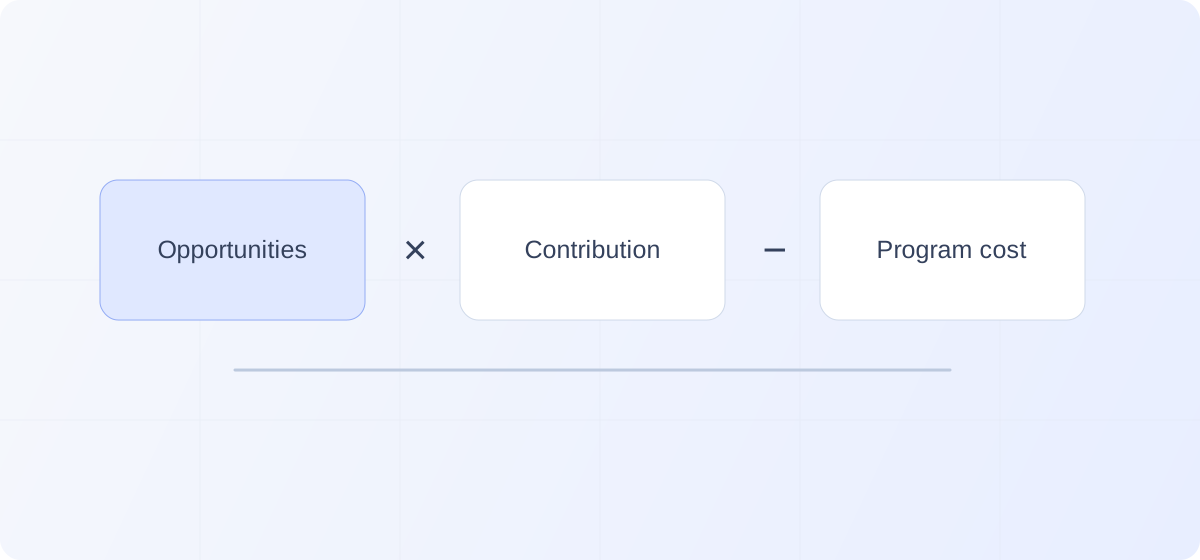
TL;DR: An inbound AI SDR business case holds up when the gross margin expected from genuinely additional customers, plus verified savings, exceeds the full program cost, including internal time, over the same defined period. Pipeline divided by cost is not ROI. Use win rates from comparable opportunities, find break-even, test weaker scenarios, and track cash timing separately.
“One additional customer would pay for it.”
That might be true.
It leaves several questions unanswered.
Would that customer have bought anyway? How much does it cost to serve them? How long will the deal take to close? What will your team spend implementing and operating the new experience?
A credible business case for an inbound AI SDR compares the additional economic benefit the deployment is expected to create with its full cost over a defined period.
Qualified pipeline helps you assess progress. Customer contribution and actual savings determine the financial return.
The most useful question is not how large a return you can put into a presentation.
It is:
What would need to happen for this investment to make sense, and how believable are those assumptions?
Start with the improvement you are buying
An AI SDR can be considered for different reasons.
A company may want more suitable prospects to become opportunities. Another may want to reduce repetitive qualification work. A third may need to make its website responsive outside staffed hours.
Those objectives can overlap, but they should not be collapsed into one impressive-looking number.
Write down the main economic hypothesis.
For example:
“Relevant prospects reach our product pages with questions that are not consistently resolved. A useful conversation should help some of them progress into qualified opportunities that our current experience does not produce.”
That gives the investment a defined job.
Then identify what evidence supports it. Recent prospect questions, missed handoffs, and a clearly understood conversion gap are stronger foundations than a generic assumption that AI will improve the website.
There may also be valuable benefits you cannot yet quantify. Better prospect understanding and clearer handoffs can matter without being assigned invented dollar values.
Keep them visible as supporting benefits.
Build the financial case from the parts you can explain.
Count additional opportunities, not every opportunity touched
Suppose an AI SDR participates in 15 meetings.
Some of those prospects may have used the demo form if the conversation had not been available. Others may already have been engaged with the company. A few may represent genuinely additional opportunities.
All 15 interactions can be useful. Their economic contributions are different.
The business case should distinguish participation from incrementality.
Google’s Conversion Lift documentation illustrates the principle in advertising: it compares a treatment group with a control group to estimate conversions caused by the intervention. The same underlying question applies when assessing a website change, although the experiment itself must be designed for that website.
Where the traffic and sales volume support it, a controlled comparison can help estimate additional outcomes.
Where they do not, use a carefully described baseline and acknowledge uncertainty. Do not make the model precise simply because the evidence is limited.
Count each accepted opportunity once. Several contacts, conversations, or meetings around the same purchase do not create several purchases.
Your starting quantity is the additional commercial opportunities the change is expected to produce.
Use the economics of the customers you expect to win
A company-wide average can be misleading when the website serves different segments.
A small-business prospect and an enterprise prospect may have different contract values, sales cycles, win rates, and delivery costs.
Build the case around the segment the deployment will actually serve.
Use first-year contract value when that provides a clear starting point. Keep one-time services and recurring revenue distinguishable. Use a realistic margin for serving those customers.
Stripe defines gross margin as the share of revenue remaining after direct delivery costs. That distinction matters because contract value is not all available to recover the cost of acquiring the customer.
A $25,000 annual contract with a 75% gross margin contributes approximately $18,750 before sales, marketing, and other operating expenses not included in that margin.
That is the more useful starting point for the investment calculation.
Your finance team may prefer a more specific incremental contribution measure. Use it consistently, and avoid counting the same costs twice.
Include the work around the subscription
The subscription is one cost.
The business may also incur implementation time, knowledge preparation, internal review, integration work, ongoing monitoring, usage charges, and additional sales effort to handle the resulting opportunities.
Some of these create new cash expenditure. Others use existing employee capacity.
Show the difference.
An hour from a salaried employee does not automatically create an extra hour of payroll cost. It still has an opportunity cost if that person could have spent the time on other valuable work.
For an economic return calculation, account for the resources consumed. For a cash-payback calculation, track when money actually leaves and enters the business.
Also examine what can genuinely be removed.
An existing contract is not a saving merely because the team expects to cancel it at the next renewal. The expenditure continues until the obligation changes.
Likewise, saving qualification time does not automatically eliminate a salary. The benefit may be capacity for more productive work, rather than immediate cash savings.
Both can matter. Label them honestly.
Build a model small enough to challenge
A useful initial model can be expressed as:
Expected first-year customer contribution
= additional accepted opportunities × expected opportunity-to-customer conversion × average first-year contract value × applicable gross margin.
Then:
Modeled return
= (expected contribution + verified savings − total incremental program cost) ÷ total incremental program cost.
This is a simplified decision model. It is not a substitute for a cash-flow forecast or a formal accounting result.
Consider the following fictional scenario. These are illustrative assumptions, not Kassie results, industry benchmarks, or a pricing quote.
| Assumption | Illustrative value |
|---|---|
| Additional accepted opportunities from one year of deployment | 10 |
| Eventual win rate for those opportunities | 20% |
| Average first-year contract value | $25,000 |
| Gross margin on that customer revenue | 75% |
| Total incremental program cost | $15,000 |
| Separately claimed cost savings | $0 |
The ten opportunities represent $250,000 of potential first-year contract value.
At the assumed win rate, they produce two expected customers and $50,000 of first-year contracted revenue. Applying the assumed margin produces $37,500 of expected customer contribution.
After the $15,000 program cost, the modeled net benefit is $22,500.
The resulting modeled return is 150%.
That is materially different from dividing $250,000 of pipeline by $15,000 of cost and calling the result ROI.
The pipeline still has to convert. The customer revenue still has delivery costs. The assumptions still need evidence.
This example values the first contract year of customers eventually won from the deployment’s opportunity cohort. It does not claim that all of that revenue will be earned or collected during the first year after installation.
Find the break-even requirement
The model becomes more useful when you work backward.
Under the example’s assumptions, each additional accepted opportunity has an expected first-year contribution of:
20% × $25,000 × 75% = $3,750.
Recovering the $15,000 program cost therefore requires approximately four additional accepted opportunities in expected-value terms.
That does not mean four opportunities guarantee payback. A small group might produce no customers, one customer, or several.
It gives the team a requirement to examine.
Can the proposed website journey plausibly produce that many additional opportunities? Is there enough relevant traffic? Does the product solve an actual obstacle? Does the sales team have the capacity to work the opportunities well?
This is where the business case becomes operational.
A low break-even number can still be unrealistic on a website with almost no commercial demand.
A higher number can be credible for a business with a well-understood audience and a demonstrated conversion problem.
The arithmetic identifies what must happen. The market evidence determines whether to believe it.
Test the assumptions that could disappoint you
Do not stop at the base case.
Using the same fictional contract value, margin, and program cost, consider three possible outcomes:
| Scenario | Additional accepted opportunities | Assumed win rate | Expected customers | Expected first-year contribution | Modeled return |
|---|---|---|---|---|---|
| Weaker outcome | 5 | 10% | 0.5 | $9,375 | −37.5% |
| Base case | 10 | 20% | 2 | $37,500 | 150% |
| Stronger outcome | 15 | 20% | 3 | $56,250 | 275% |
Fractional customers represent probability-weighted expectations. Actual customer counts will be whole numbers.
The weaker scenario matters.
It shows that an apparently modest change in opportunity volume and quality can turn an attractive investment into one that fails to recover its cost.
That does not mean the purchase is wrong. It identifies the uncertainty you need to manage.
Use comparable historical opportunities when estimating win rates. A rate calculated from referrals or hand-picked enterprise deals may not describe a new website-conversation channel.
Where evidence is thin, widen the range rather than borrowing confidence from an unrelated segment.
Put the return on a calendar
A positive expected return does not tell you when the business gets its money back.
You may pay for the deployment now, create opportunities over the next several months, and collect customer payments later.
An annual subscription sale also does not make the entire contract accounting revenue on the day payment arrives. For services delivered over time, revenue recognition generally follows the service period; Stripe’s subscription guidance illustrates that distinction for annual prepaid SaaS contracts.
Keep three views separate.
Pipeline shows potential purchases.
Customer economics show the contribution expected from the business you win.
Cash flow shows when payments and expenditures actually occur.
A business case can be attractive while requiring more patience than the company’s cash position allows.
For longer sales cycles, map the anticipated cash flows and use an appropriate financial review. Do not compare a full lifetime of hypothetical customer value with one year of program costs.
Begin with a horizon you can defend. Add future renewals and expansion only when you have a reasonable basis for estimating them.
Do not count the same benefit twice
An AI SDR might reduce manual qualification work and help create additional opportunities.
Both benefits can be real.
But suppose the same saved hours are the reason the team can handle those additional opportunities. Counting the entire value of the extra business and a fully eliminated salary may overstate what changed.
Similarly, a removed software cost cannot be claimed if the product remains necessary for customer support.
Keep each benefit tied to a specific change.
For time savings, explain how the capacity will be used. For avoided hiring, identify the workload and hiring plan that would otherwise have been required. For additional customer contribution, show the incremental opportunities behind the estimate.
A smaller case with traceable assumptions is more useful than a larger one built from overlapping benefits.
Review the investment as evidence arrives
Early results will not answer every financial question.
You can assess whether conversations are accurate and whether booking works before enough opportunities have matured to calculate a reliable win rate.
Review the evidence in sequence.
First, confirm that the deployment works for the intended prospects. Then assess whether the resulting meetings and opportunities meet the agreed standard. Later, examine the customers, contribution, and cash actually produced.
Update the model.
If opportunity quality is lower than expected, change the assumption. If operation requires more time than planned, include the cost. If the product removes work you had not anticipated, document the benefit.
The business case should become more accurate as the deployment matures.
It should not remain frozen at the numbers used to approve the purchase.
Frequently asked questions
Is pipeline generated divided by software cost a valid ROI calculation?
It is a pipeline-to-cost ratio, not financial ROI. Pipeline is potential business. A financial case needs to account for conversion to customers, the cost of serving them, operating costs, and timing.
Can an AI SDR be worthwhile without reducing headcount?
Yes. Additional profitable business, better use of existing capacity, and reduced avoidable expenditure can justify the investment. Distinguish capacity gains from actual payroll savings.
Which win rate should we use before we have results?
Start with comparable opportunities from the same segment and a similar stage of qualification. Where the comparison is weak, use a range and explain the uncertainty. Replace the estimate with observed results as the new cohort develops.
Make the investment earn its place
Kassie’s focus is helping B2B companies generate more qualified pipeline from website prospects through useful conversations, qualification, and meeting booking.
The economic case should begin with your business.
Which prospects could receive better help? How many additional opportunities would make the investment worthwhile? What would those opportunities need to become? What will it cost to operate the experience well?
Answer those questions clearly.
Then the decision becomes more grounded than a promise of enormous pipeline or the claim that one customer will pay for everything.
You know what success requires, what remains uncertain, and how you will judge the result.