
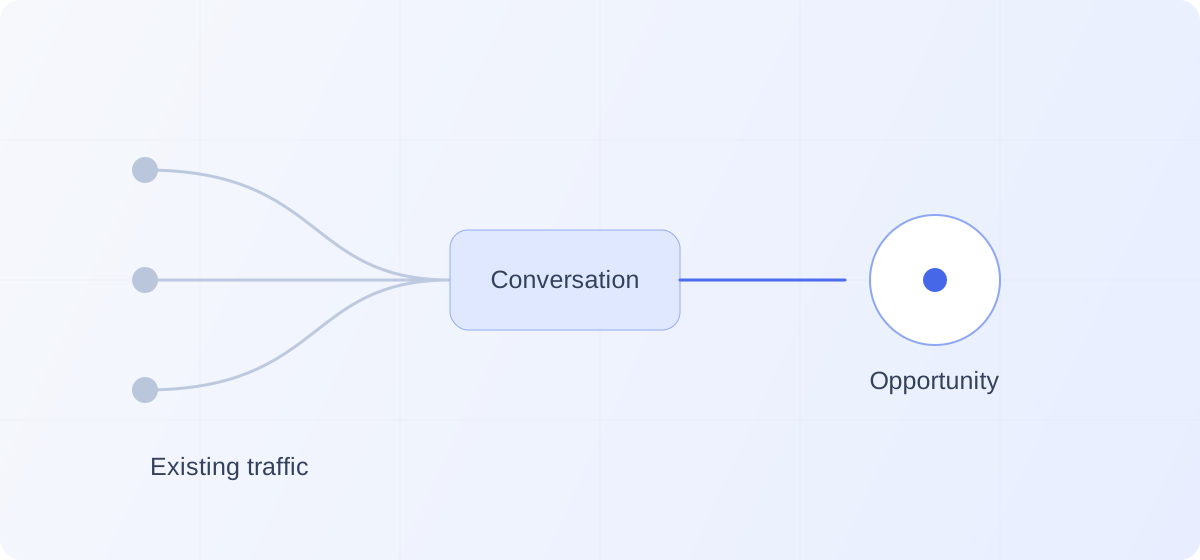
TL;DR: If your traffic already includes suitable prospects, grow qualified pipeline by finding and fixing what holds them back, such as unclear fit, unanswered questions, slow scheduling, or handoffs that lose context. Define what earns a sales conversation. Tackle one obstacle at a time, then follow those prospects until sales accepts or declines them as opportunities.
Before you commit to another traffic campaign, ask a more specific question:
What would need to change for more of the right people already visiting your website to become real opportunities?
Perhaps prospects cannot tell whether the product fits their situation. Perhaps they have questions the website does not answer. Perhaps they are ready to meet, but scheduling introduces a delay your team could remove.
Each problem calls for a different response. Increasing traffic leaves the underlying experience unchanged.
To turn existing website traffic into qualified pipeline, help relevant prospects understand your product, resolve their questions, establish fit, and take a useful next step. Then follow those prospects into the sales process to determine whether genuine opportunities develop.
The work begins with understanding where your current journey falls short.
1. Find the commercial opportunity inside your traffic
Start with a manageable part of the website.
Choose a product, use case, or customer segment your business already serves well. Then examine how prospects researching that area arrive, what they encounter, and what happens afterward.
Your most visited page is not automatically the best place to begin.
An educational article might attract a large audience with broad interests. A product page with fewer visits might serve people evaluating a problem your company can solve today.
Look for evidence connecting the traffic to relevant commercial interest.
Review the questions appearing in inquiries. Look at the companies behind recent opportunities. Ask customers what they needed to understand when they first evaluated you. Where your tracking permits it, connect those findings to the pages and sources involved.
Google Analytics’ Landing page report can help organize this investigation. It shows where sessions begin, and adding the session source and medium lets you examine the relationship between an entry page and its traffic sources. It does not establish commercial fit on its own.
Use the website data to decide where to look, then use prospect and customer evidence to understand what you are seeing.
A practical starting point is:
“This part of the website attracts people researching a problem we solve well. Some become customers. What prevents other suitable prospects from progressing?”
That is a stronger basis for improvement than assuming every visitor who leaves represents lost revenue.
If you cannot yet identify relevant demand, investigate your audience and positioning first. A more responsive website cannot compensate for attracting people your business is not equipped to serve.
2. Carry the original promise onto the page
A prospect should recognize why they clicked as soon as they arrive.
Imagine a campaign aimed at finance leaders struggling to coordinate software renewals. The campaign offers a clear promise: understand upcoming renewals and avoid paying for products the company no longer needs.
The destination page opens with:
“The intelligent platform for modern enterprise transformation.”
The prospect now has to find the connection between the problem that caught their attention and the product in front of them.
For that fictional campaign, a more useful opening would explain how the product helps finance teams track renewals, understand usage, and decide what to keep. A relevant product view could show where those decisions happen.
Google’s landing-page guidance makes the same underlying recommendation: match the page to the expectations created by the advertisement, make the offer easy to find, and provide useful information that helps people take action.
Apply that logic beyond paid campaigns.
A referral, comparison article, search result, or LinkedIn post also creates an expectation. Review whether the page fulfills it.
The prospect should be able to answer three questions without translating your internal vocabulary:
-
Is this built for a situation like ours?
-
What would it help us accomplish?
-
What can I see that makes the claim credible?
Technical detail has a place. So does an ambitious company vision. But the first explanation should help the prospect recognize their own problem.
Clarity gives a suitable prospect a reason to keep evaluating.
3. Give prospects useful help before asking them to commit
Once the product appears relevant, the questions become more specific.
A prospect may understand what your platform does but still need to know how it fits an existing process. Another may be ready to evaluate but uncertain about implementation or pricing.
Make common answers easy to find. Give prospects a way to discuss the questions that depend on their circumstances.
This is not a new requirement created by AI. Nielsen Norman Group’s B2B usability research identified incomplete product information and registration barriers as obstacles to evaluation. Its recommendation was to provide enough accessible information for prospects to judge whether a solution applies to their situation.
The practical implication is straightforward: do not make a conversation carry the burden of explaining information that should already be clear.
Publish the basic pricing model. Explain important limitations. Show the product doing the work. Make relevant integration and security information discoverable.
Then use conversation where it adds something the page cannot.
Consider a prospect who asks:
“Can we introduce this without changing the process our regional teams already use?”
The useful response depends on what they need to preserve. They may be concerned about approvals, reporting, or adoption.
A conversation can clarify the concern and explain the relevant capability. It can also reveal that the product cannot meet the requirement.
Either answer helps the prospect make a better decision.
Keep the other paths available, too. Someone who wants to book should not be forced to converse first. Someone who can purchase or start using the product independently should not be diverted into unnecessary qualification.
Make help available at the point of uncertainty. Let readiness determine the next step.
4. Agree on what deserves a sales conversation
Before increasing conversion, define what you are trying to convert people into.
A contact record, a booked meeting, and a sales opportunity represent different levels of progress. HubSpot’s default lifecycle stages make this distinction explicit: a lead has engaged with the business, a sales-qualified lead has been assessed as a potential customer, and an opportunity is associated with a deal.
Your company should establish its own acceptance criteria.
Which use cases do you serve? What requirements would rule someone out? What needs to be understood before a meeting becomes a worthwhile use of the prospect’s time and yours?
Keep the initial standard proportionate.
You may need to know the company’s situation and the problem they are evaluating. You may not need a confirmed budget, a complete buying committee, and an exact purchase date before allowing a useful first conversation.
The qualification process should establish enough fit to choose the next step. Deeper discovery can happen when the situation warrants it.
Consider two prospects from companies that match your employee-size target.
One is replacing a product your business competes with and has a requirement you support well. The other is researching a capability you do not offer.
Their company profiles look similar. Their commercial relevance is different.
Use what the prospect tells you to make the distinction. Ask for missing context when it matters, and avoid repeating information they have already provided.
A clear qualification standard also gives marketing and sales a shared definition of progress. Otherwise, one team can celebrate more meetings while the other spends more time declining them.
5. Let a qualified prospect complete the next step
When someone wants to meet and meets your criteria, make the path clear.
They should understand who they will speak with, what the conversation is for, and how to secure a time.
Where the workflow permits it, let them book immediately. This does not necessarily require replacing an existing form. Scheduling systems can apply qualification and routing rules to form responses and present an appropriate calendar afterward. Calendly documents this approach for both its own forms and supported marketing forms.
A conversational experience should aim for the same continuity.
If a prospect has already explained their situation, asking them to repeat it in a separate intake flow adds work without necessarily adding understanding.
Test the complete journey yourself.
Use a phone as well as a desktop. Check whether time zones are clear, whether available appointments are realistic, and whether the confirmation gives the prospect everything they need.
Also test the less convenient cases.
What happens when the assigned representative has no availability? What happens when the calendar connection fails? What happens when the prospect needs a specialist?
An immediate booking path is valuable only when it works. Where a human needs to intervene, make the fallback explicit and give someone responsibility for completing it.
The objective is a confirmed next step the prospect understands.
6. Send the context forward with the prospect
A meeting can be booked correctly and still begin badly.
That happens when the next person knows a meeting exists but does not know why.
Compare two handoffs in a fictional sales process.
The first says:
“Demo request. Operations director. 200 employees.”
The second says:
“Evaluating a replacement before the current contract renews in January. Wants to start with one department. Main concern is preserving regional approval workflows. Asked about the integration and needs a walkthrough of how approvals would work.”
The second gives the salesperson somewhere useful to begin.
Build that continuity into the process. Preserve the prospect’s stated problem, relevant requirements, unresolved questions, and agreed next step. Keep the original conversation accessible when a summary needs verification.
Separate what the prospect actually said from anything your system inferred. Do not turn a vague expression of interest into a confirmed purchase deadline.
Assign an owner, too.
A well-written summary sitting in an unmonitored channel does not complete a handoff. The person responsible for the next interaction needs to receive it in a place they use.
This is part of website conversion. The experience continues after the visitor leaves the page.
7. Measure the opportunities that develop
Your website can become busier without becoming more productive.
More conversations, form submissions, and bookings are useful signals. Follow them far enough to see whether they result in opportunities your sales team accepts.
The tracking needs to distinguish stages rather than count every interaction as the same outcome. Google Analytics supports separate recommended events for lead generation, qualification, disqualification, and closed lead outcomes. These require configuration; the system does not determine qualification merely because someone visits a page.
Keep your first measurement model simple.
For a selected website journey, record how many people visit, how many meetings are booked and held, and how many new qualified opportunities develop. Associate those opportunities with credible values in your CRM.
Here is a fictional planning example, not a benchmark or a forecast:
| Outcome for comparable visitor cohorts | Existing journey | Improved journey |
|---|---|---|
| Visitors to the selected commercial pages | 5,000 | 5,000 |
| Meetings booked | 50 | 60 |
| Meetings held | 40 | 48 |
| New qualified opportunities accepted by sales | 20 | 24 |
| Average first-year opportunity value | $25,000 | $25,000 |
| Qualified pipeline created | $500,000 | $600,000 |
The example holds traffic volume, meeting attendance, opportunity acceptance, and average opportunity value constant while increasing the booking rate.
That produces four additional accepted opportunities and $100,000 more pipeline.
It does not produce $100,000 of revenue. The opportunities still need to close.
Nor does a before-and-after change prove that a particular website update caused the improvement. Traffic mix, campaigns, seasonality, and other changes can affect the result.
Where volume permits, compare similar visitors through a controlled test. Otherwise, combine the numbers with direct prospect feedback and treat the conclusion with appropriate caution. Allow enough time for each visitor cohort to progress before comparing outcomes.
Measure the whole journey across conversion paths. Moving ten bookings from a form into a conversation is not ten additional bookings.
And count each opportunity once, even when several people or interactions contributed to it.
8. Improve one constraint, then reassess
You do not need to redesign the entire website to begin.
Choose one commercially relevant journey and one problem you can explain precisely.
Perhaps prospects cannot determine which plan fits their requirements. Perhaps qualified form submissions wait for manual routing. Perhaps the sales team repeatedly rejects meetings for the same unsupported use case.
Write down the hypothesis, the proposed change, and the result that would make the work worthwhile.
For example:
“Prospects evaluating this product need to understand a specific deployment requirement. We will make that information clear on the page and provide a way to ask follow-up questions. We will assess whether more suitable prospects progress to held meetings and accepted opportunities.”
Review what happens with the people who own the website, qualification, and follow-up.
Read the questions. Examine the rejected opportunities. Check where the process failed. Feed recurring uncertainty back into the page and the approved product knowledge.
Make the next change from that evidence.
Over time, this creates a website-improvement process tied to commercial outcomes rather than a series of redesigns based on preference.
Where Kassie fits
Kassie focuses on the conversation between a prospect arriving and a qualified next step.
She answers questions using approved business knowledge, applies the company’s qualification criteria, and helps qualified prospects book with the sales team inside the conversation.
That can support a website where relevant prospects need help understanding fit or resolving uncertainty.
The surrounding work still matters. Clear positioning, useful product information, reliable scheduling, and a prepared sales team give the conversation somewhere valuable to go.
Deploying an AI SDR should be part of improving that complete experience. Evaluate her contribution by what changes for prospects and the pipeline that follows.
Frequently asked questions
Can a B2B website generate more pipeline without increasing traffic?
Yes, when existing traffic includes suitable prospects whose progress is being limited by avoidable confusion, unanswered questions, or process friction. Improving those conditions can increase the share who become qualified opportunities. The opportunity depends on your current audience and conversion process.
How much website traffic do you need before improving conversion?
There is no useful universal threshold. Consider the amount of relevant traffic, the value of the opportunities, the cost of the improvement, and how much evidence you need to evaluate it. A lower-volume business with valuable contracts may still have a worthwhile opportunity, but it will take longer to measure changes reliably.
Should you replace a demo form with a conversation?
Only when evidence supports that change. Preserve a form that works for prospects ready to meet. A conversation can provide another path for people who need answers first, or support qualification and scheduling within the broader journey.
What is the first improvement to make?
Start with a specific obstacle affecting prospects your business can serve. Review recent inquiries and sales conversations, inspect the relevant website journey, and identify what prevents a useful next step. Fix that obstacle before adding more complexity.
Make the next visit more useful
You can keep investing in discovery while improving what happens after someone finds you.
Choose one important journey. Make the promise clear. Help prospects resolve what matters. Establish fit, complete the next step, and preserve the context.
Then ask whether more worthwhile opportunities came through.
That is how a website earns a larger role in revenue generation.
The goal is to generate more qualified pipeline from traffic you already have.