
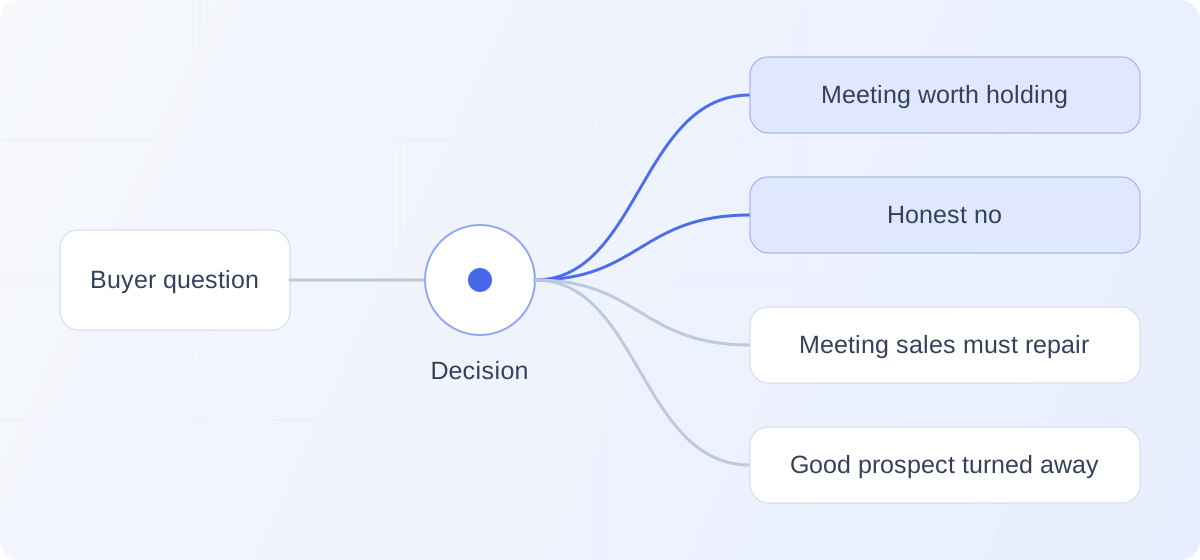
An AI SDR can answer immediately, hold a convincing conversation and book a meeting that your sales team should never have taken. She can also reject a good prospect and leave no meeting for anyone to review. Both are failures of judgment, but only one is likely to appear on the sales team's calendar.
To evaluate an inbound AI SDR's qualification decisions, review conversations that led to booked meetings and those where prospects were rejected. Check whether each booked meeting reflected an accurate understanding of the buyer's needs, and whether each rejection rested on a genuine mismatch. Then track held meetings, sales acceptance and the next steps buyers take, rather than response speed or bookings alone.
In his October 22 newsletter, “AI SDR’s Second Wave,” Adam Schoenfeld argues that inbound is the next major opportunity for AI SDRs, emphasizing buyer-facing agents and the infrastructure behind them. We agree with the direction. The next question is how we judge the decisions those agents make.
Our founder worked as an SDR. The standard we set for Kassie is whether she helps suitable buyers move forward, recognizes genuine mismatches and knows when another person needs to get involved.
Why judge the decision before the outcome?
An inbound agent has several useful options. She can answer a question, ask for clarification, offer a meeting, involve a specialist or explain that a requirement is unsupported.
The right choice depends on what the buyer needs.
A booking target can push all those situations toward the same result. A product limitation becomes something the account executive can explain later. A technical uncertainty becomes a reassuring answer. The calendar fills while the work of correcting expectations moves downstream.
That is why a conversation review should start with the decision: what did the agent know, what did she assume, and was her next step appropriate?
Our inbound versus outbound AI SDR guide explains the different starting conditions. Inbound gives the agent an active question to work with. Her advantage depends on using that question well.
How do you spot meetings sales has to repair?
Consider a hypothetical buyer evaluating expense-management software. They ask whether purchase approvals can remain in their existing ERP. The agent says yes and books a demo. The rep later discovers that the integration imports completed expenses but does not support that approval workflow.
The agent secured a meeting by leaving the buyer with the wrong understanding.
The repair starts before scheduling. She should explain the supported workflow and clarify whether keeping ERP approvals is mandatory. If the requirement is unclear, a specialist can help establish fit. If it is essential and unsupported, the buyer deserves a direct answer.
Sales should therefore review what arrived with the meeting. Was the use case captured accurately? Were important limitations disclosed? Did the prospect understand the purpose of the call? How much time did the rep spend undoing what the agent had said?
Track held meetings, sales acceptance and buyer progress, then connect each outcome to the original conversation. A technical evaluation, a relevant stakeholder joining or a mutually agreed next step can show progress. The evidence helps locate the decision that made the meeting useful or wasted it.
Rejection reasons matter just as much. “Bad lead” tells the team almost nothing. “Needs an approval workflow we do not support” identifies a specific boundary the agent should have recognized.
How do you find good prospects she turned away?
Now return to the same hypothetical buyer, before a meeting has been offered. They are an operations manager researching options for the finance director. They cannot name an approved budget because the team is still comparing approaches.
An agent that insists on budget and purchasing authority might end the conversation there. Yet the visitor could describe a relevant problem, represent a suitable company and have a clear path to the decision-maker.
The missing budget should prompt a decision about what information is necessary now. It should not silently become evidence that the company cannot buy.
Review rejected and abandoned conversations alongside accepted meetings. For each rejection, identify the exact fact that triggered it. Was that a genuine disqualifier? Was the information absent, or had the buyer actually given a negative answer? Could one useful clarification have changed the next step?
This is where sales should challenge the qualification policy itself. An agent can follow a rule perfectly while the rule filters out buyers the company wants.
Have a sales representative independently review a sample without seeing the agent's score first. Compare decisions, then examine the disagreements. A reviewer should be able to explain why they would continue, reject or escalate using evidence from the conversation.
Include conversations where the agent expressed uncertainty. Those are often the cases that reveal whether your policy gives her enough room to make a sound decision.
How do you turn a review into a better decision next time?
Keep a short record for each disputed interaction: the buyer's need, the agent's choice, the evidence behind it and the preferred next step.
Then assign the correction. A false product claim needs an approved answer. A good prospect rejected for missing budget may require a qualification-rule change. A confused handoff may need better context for the rep. Each correction should be tested against the original exchange and a nearby variation.
Our website measurement guide covers the funnel and reporting definitions. Use it to track commercial outcomes while this review explains which decisions to improve.
There is plenty of new capability to evaluate. Clay's Sculpt recap previewed voice qualification and product demonstrations; its inbound page still describes a waitlist and phased shipping beginning in fall 2026, as checked on October 22.
As these products develop, we want vendors, including Kassie, to show how their agents handle difficult decisions. Show a relevant buyer who was allowed through despite incomplete information. Show an unsupported requirement handled honestly. Show what changed after sales challenged a rejection.
Talk to Kassie about your qualification process. Bring a buyer situation your team finds difficult, and assess the next step she recommends.