
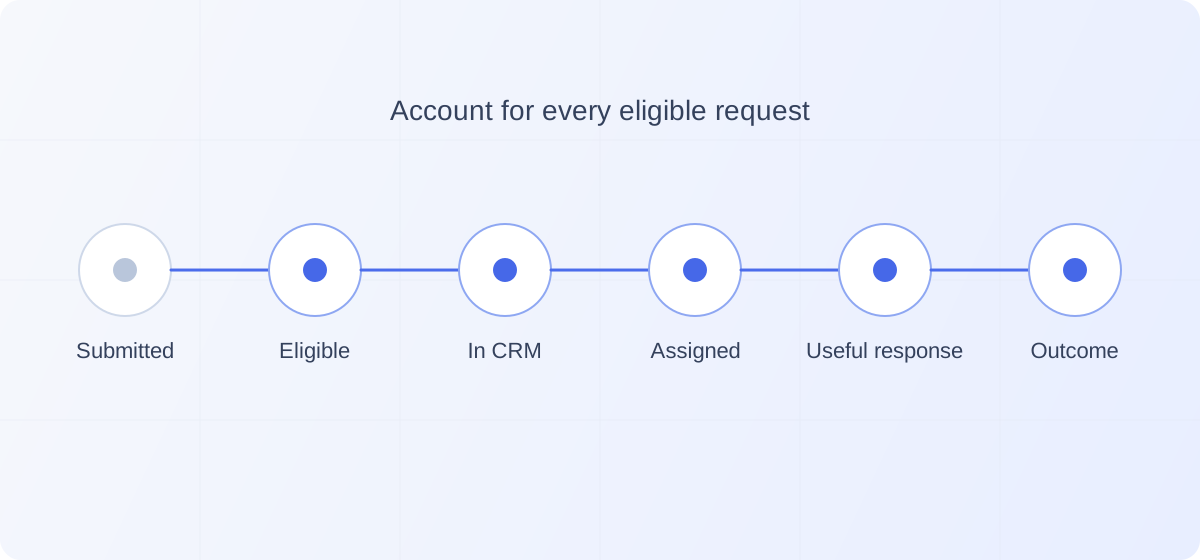
Clay reported 2,013 email responses from 6,346 demo and contact form submissions, roughly 32%. The experiment used one automated identity, so it cannot show how much qualified pipeline was lost. To audit your own inbound, follow every eligible request from submission through CRM record, ownership and a useful response, then fix the step where requests go missing.
Its published experiment gives revenue teams a concrete question to take back to their own systems: can we account for what happens to every eligible request? A slow response, a missing record and an unassigned lead require different fixes, so your team needs to know which problem it has.
What does Clay’s experiment show, and what can’t it prove?
Clay used automated submissions with one consistent identity and AI to classify aspects of the replies. As Clay acknowledges, buyer fit, spam or bot filtering and classification errors limit what the results establish. An unobserved email response could reflect a missed inquiry or a deliberate filtering decision. The study does not establish how much qualified pipeline was lost. Its reported response rate describes this experiment, rather than predicting what your own prospects experience.
Your records can answer questions the external experiment could not. Did the request arrive? Was it eligible for sales? Who owned it? Did the buyer get a useful response? What happened next?
Those questions turn a headline into an operating review. You can identify a broken step, assign someone to fix it and check whether the repair worked.
Where should an inbound audit start?
Choose a recent, completed period and one conversion path, such as demo requests from your main website. Work from your own inbound records.
Begin with the form system's submission log, then reconcile it with CRM records. Starting inside the CRM would exclude precisely the requests that failed to arrive there.
Where the systems permit it, follow a submission identifier across form receipt, integration delivery, record creation, assignment and response. Keep retries and duplicate records visible without counting them as new prospects. Use access-controlled records and avoid copying personal information into unnecessary working files.
Create an eligibility decision for each request. Separate spam, tests, duplicates, customer-support requests and prospects outside your service scope. Preserve the reason and the count. Leave uncertain cases marked for review.
Report the raw submission total alongside the eligible prospect total. A company with heavy spam should not look commercially unresponsive because it declined junk. Equally, “bad fit” should not become a convenient label for requests nobody examined.
Give marketing and sales the same exclusion list to review. If marketing calls a request qualified and sales calls it irrelevant, settle the reason before using the resulting rate to judge either team.
How do you find where requests are delayed or lost?
The audit should distinguish receipt, assignment, acknowledgment, first useful response, booking and subsequent outcomes.
A first useful response addresses the request or supplies a relevant next step. It could answer a deployment question, ask a necessary clarification or provide an appropriate scheduling path. A generic receipt confirmation serves a different purpose.
We explain that distinction more fully in Speed to lead starts before the lead exists. For this audit, record the separate events rather than giving them one timestamp.
Here is a hypothetical audit of 100 submissions received during a completed period:
| Audit finding | Count | Next investigation |
|---|---|---|
| Excluded with documented reasons | 20 | Review ambiguous exclusions |
| Eligible prospect requests | 80 | Follow all 80 through the process |
| Eligible requests found in the CRM | 72 | Investigate eight missing records |
| CRM requests with a useful response | 65 | Inspect seven unresolved cases |
The eight missing records need an integration investigation. The seven unresolved cases need a review of ownership and follow-up.
For the missing records, check delivery errors, retry history and field-validation failures. For the unresolved cases, check whether an owner was assigned, whether a notification arrived and whether someone actually acted. A notification sent is not proof that the request was worked.
Among the same 80 eligible requests, suppose 24 booked, 18 held a meeting and nine became accepted opportunities within the chosen observation window. Link those outcomes to the original requests so the team can see which paths produced worthwhile sales conversations.
Keep reschedules and pending outcomes separate. Report response coverage alongside response times among those who received a response. Otherwise, fast handling of a small fraction can conceal the rest.
How do you fix what the audit finds?
Missing CRM records call for delivery checks and recovery. Unassigned prospects call for ownership rules. Repeated clarification of the same product question may call for better website information. Long waits after assignment may call for changes to coverage or workflow.
Choose an owner and a completion check for each fix. An integration repair is complete when a controlled submission reaches the correct record and owner. A routing change is complete when the right person receives and handles the request, including when the usual owner is unavailable.
An inbound AI SDR could help answer and qualify requests while a buyer is engaged. She still needs an accurate qualification policy, working handoffs and useful calendar availability. The audit tells you which foundations need attention before adding another conversion path.
Review a new cohort after the changes using the same definitions and observation window. Keep traffic source and offer changes visible so you can interpret the result. Also record how much manual checking remains necessary; an improvement that depends on someone watching every request has an ongoing operating cost.
For downstream measurement, use our website-to-pipeline guide. The immediate deliverable is a list of unexplained requests, their owners and the changes needed to resolve them.
Bring that list when you talk to Kassie. We can discuss where buyer conversations could help your inbound process and what needs fixing elsewhere first.