
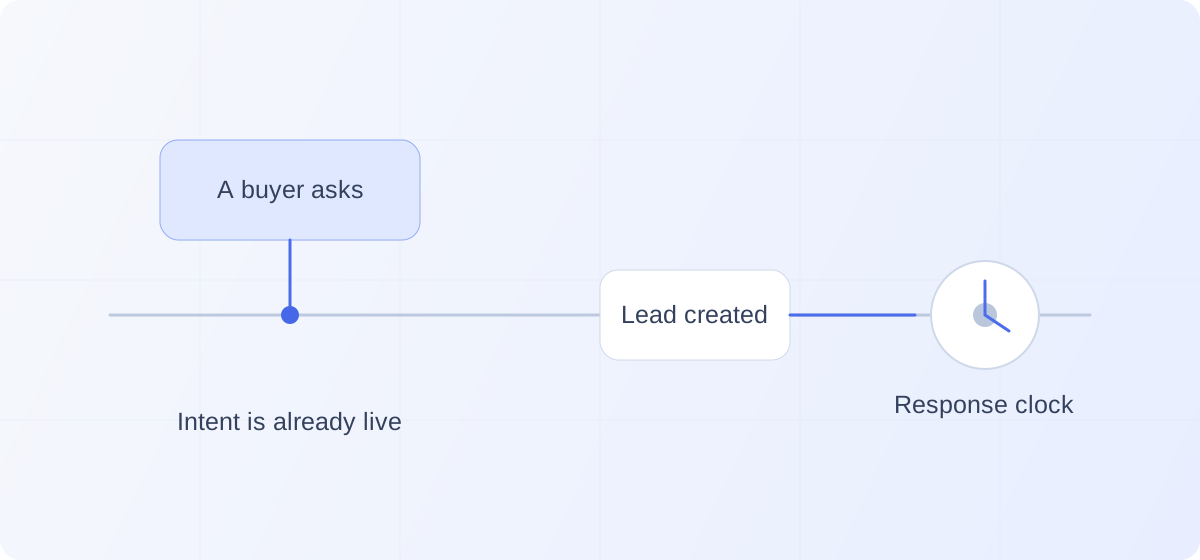
TL;DR: Speed to lead is usually measured from a prospect’s inquiry, but their need for help often begins earlier, with an unanswered question. Answer ordinary product questions accurately on the website, without requiring contact details first. Keep existing response metrics, but also time each request until it receives useful help, not just confirmation of receipt.
Your team can respond quickly and still leave a prospect waiting.
Speed to lead usually measures how quickly a business follows up after someone expresses interest, such as by submitting an inquiry or requesting a demo. HubSpot describes lead response time in these terms: the interval between a prospect expressing interest and the team following up.
That is a useful measure. It starts after the prospect has done something visible.
But consider what happened just before.
They were on your website. They had a question. They could not find an answer. Eventually, they submitted a form.
Your response-time report starts there.
Their need for help started earlier.
For a B2B website, improving responsiveness should include the experience before a prospect becomes a lead in your CRM.
The opportunity is to answer what is holding them back while they are still evaluating, rather than making them request a meeting before the company becomes helpful.
Two minutes on your dashboard can feel very different to a prospect
Consider this fictional website visit.
At 10:02, a prospect reaches your pricing page. They want to know whether external collaborators need paid licenses. The answer affects whether your product is affordable for their use case.
They look through the plans, open another page, and return to pricing.
At 10:08, they submit a demo request.
At 10:10, a representative replies:
“Thanks for reaching out. Here’s my calendar to schedule a call.”
Your team responded in two minutes.
The prospect has been trying to resolve the question for eight. They still do not have the answer.
That does not mean the representative did something wrong. They may have followed the process exactly.
It means the process rewards a milestone that is different from the progress the prospect needed.
Now consider someone who leaves at 10:07 instead of submitting.
Your response-time report has nothing to say about them.
This is the gap: a business can become excellent at responding to leads without becoming equally good at helping people become leads.
Know which clock you are improving
Even after someone makes contact, “speed to lead” can describe different intervals.
How quickly was the inquiry captured? How quickly did it reach the appropriate person? How quickly did that person respond? When did the prospect receive useful help?
Those are related, but they are not interchangeable.
In a 2024 account of its own marketing operations, Salesforce reported reducing lead-assignment time from 20 minutes to 20 seconds. The improvement concerned getting leads to sales teams faster. It was not a claim that every prospect received a substantive answer within 20 seconds.
Faster assignment removes an internal delay. That matters.
But it is one part of the prospect’s experience.
A record can reach the correct owner immediately and still wait for attention. A reply can go out promptly without addressing the request. A question can receive an answer, followed by unnecessary back-and-forth to arrange the next step.
Before setting a faster target, establish what your current number actually measures.
A shorter internal process is valuable when it helps the prospect make progress sooner.
An acknowledgment is useful. An answer does more.
There is nothing wrong with confirming that you received a request.
A confirmation can reassure the prospect that their message arrived and explain what happens next.
It should not be mistaken for resolving the reason they contacted you.
Return to the licensing question.
In our fictional example, suppose the product’s approved pricing policy clearly allows external collaborators to view work without a paid license.
A useful answer could be:
“External collaborators can view work without a paid license. They need one if they’ll be creating or editing it.”
That gives the prospect something they can use immediately.
They may now want to meet. They may ask a follow-up question. They may discover the product is not suitable.
Each outcome reflects a better-informed decision.
Contrast that with asking for their company size, phone number, and buying timeline before explaining the licensing rule. You might collect a more complete record while leaving the original uncertainty untouched.
The response should follow the request.
Someone asking to book a demo needs an easy way to book. Someone asking a product question needs an answer. Someone describing an unusual requirement may need a clarifying question or help from a specialist.
A calendar link can be exactly right in one situation and an unnecessary detour in another.
Make useful help available before the form
Concern about slow follow-up predates AI. Harvard Business Review’s 2011 article The Short Life of Online Sales Leads warned about delayed responses to internet-generated inquiries.
That problem still deserves attention. But making follow-up faster is not the only way to shorten the wait.
You can also remove the need to wait for follow-up.
If many prospects ask the same pricing question, answer it on the pricing page. If a product claim consistently needs clarification, make the explanation clearer. If prospects need to see a workflow, show it.
The simplest improvement may not involve a conversation at all.
A conversation becomes valuable when the answer depends on the prospect’s circumstances, the question is difficult to anticipate, or the person needs help connecting the product to their situation.
Make that help easy to find and easy to use.
Do not require a phone number to answer a question about a publicly available feature. Do not send prospects through a qualification sequence before acknowledging what they asked.
There are legitimate reasons to request identity or additional information, particularly for account-specific or sensitive matters. Explain those reasons when they apply.
For ordinary product evaluation, the order should be natural: understand the question, provide useful help, and determine what should happen next.
The prospect should be able to get help before they are ready to become a sales lead.
Faster service should not mean a faster interrogation
Moving the conversation earlier creates another responsibility: respect where the prospect is in their evaluation.
Someone browsing your website has not agreed to a discovery call.
They may want one answer before returning to an internal discussion. They may be comparing options. They may already understand the product and want to speak with someone.
A responsive experience should adapt to those situations.
If the prospect asks a question that can be answered accurately in two sentences, answer it. If more context is necessary, ask the question that makes the answer possible.
For example:
“Will your reporting work for our partners?”
The useful clarification might be:
“Do partners need to view your reports, or create their own?”
That helps resolve the request. It is different from asking about budget simply because budget appears in a qualification checklist.
Likewise, a qualified prospect who says they are ready to meet should not be slowed down by a standard introductory sequence.
The objective is to remove unnecessary waiting, not compress every visitor into a sales process as quickly as possible.
A fast experience can still be patient.
Your office hours do not describe the prospect’s wait
An inquiry sent on Friday evening and answered shortly after opening on Monday can satisfy an internal response target.
The prospect still waited through the weekend.
Both statements can be true because business-hours reporting and elapsed-time reporting answer different questions.
Intercom’s responsiveness documentation illustrates this distinction. Its reporting can account for office hours, and its first-response metrics can include or exclude time spent assigned to a bot. Its documented first-response measure concerns a teammate’s reply, not the bot’s response.
The lesson is to read the metric definition before interpreting the number.
Business-hours reporting can help you evaluate the team against its staffing commitments. Elapsed time describes the wait from the prospect’s perspective.
Keep both views where they are useful.
That does not mean every company needs people available around the clock. It means you should decide what your website can reliably do when nobody is available.
Public product information can remain accessible. Routine questions may be answerable through an automated conversation. Appropriate prospects may be able to book an available meeting without waiting for someone to send a link.
Requests that need human judgment still need a human owner and an honest expectation about timing.
Availability should not become permission to guess.
An immediate answer that invents a capability can create a much larger problem than a clearly explained wait.
Measure the wait you can actually observe
There is a limit to the headline’s argument.
You cannot reliably timestamp the moment a visitor develops a question or decides your product might be relevant.
A page view does not reveal that. Neither does time on page.
Do not turn every website visit into a fictional stopwatch of purchase intent.
Instead, keep your existing lead-response measures and add a closer review of observable requests for help.
A simple operating model separates three moments:
| Measure | Start | Finish | What it tells you |
|---|---|---|---|
| Acknowledgment time | Prospect sends a request | Receipt is confirmed | Whether the prospect knows the request arrived |
| First substantive response | Prospect sends a request | They receive a relevant answer, necessary clarification, or specific next step | Whether help has actually begun |
| Time to complete the requested action | The request is understood | The answer, booking, or other appropriate action is completed | Whether the interaction delivered what the prospect needed |
This is a proposed way to inspect the experience, not a universal reporting standard.
A substantive response also needs a definition your team can apply consistently.
“We’ll get back to you” acknowledges the request.
“I need to confirm this deployment requirement with our technical team, and Alex will follow up tomorrow” establishes a specific next step, provided Alex owns it and the timing is realistic. The underlying question remains unresolved and should be tracked that way.
An accurate answer resolves the question.
Keep those outcomes separate.
Review some of the actual conversations alongside the timing. Otherwise, a system can appear responsive by producing quick messages that accomplish little.
Also retain the requests that never received a response. Excluding them can make a report look healthier precisely because the worst experiences disappeared from the calculation.
Find where waiting resumes
A fast first response is only the beginning.
The same prospect might then wait for someone to answer the follow-up question. They might be transferred without context. They might be asked to resubmit information before seeing a calendar.
Inspect the whole exchange, but stay focused on the delays.
Where did the prospect have to stop? What were they waiting for? Could the website have completed that step, or did a person genuinely need to intervene?
Different answers call for different fixes.
A missing product explanation calls for better information. An unanswered specialist question calls for clear ownership. An available calendar hidden behind manual email coordination calls for a simpler booking path.
A reply that ignores the prospect’s question calls for better judgment.
Faster notifications will not solve all four.
Start with a small sample of real inquiries. Follow each from the original request through the answer or next step. Look at what happened during the working day and outside it.
That review should tell you more than setting an aggressive response target without knowing where the time goes.
Speed should improve the commercial outcome
A faster response is useful because of what it enables.
It can help a prospect resolve uncertainty while they are evaluating. It can reduce the effort required to book. It can preserve the context that makes the next conversation worthwhile.
Those are reasons to improve responsiveness. They are not guarantees of conversion.
A prospect can receive an excellent answer and decide the product is not a fit. That is a legitimate outcome, not a failure to respond persuasively enough.
Likewise, a fast booking does not establish that a worthwhile opportunity exists.
As you improve the experience, examine whether suitable prospects progress more often. Look at meetings held and opportunities accepted, alongside response quality and timing.
If automated replies become faster but prospects keep repeating their questions, the work is not finished.
If the conversation generates more bookings but fewer suitable opportunities, investigate the qualification behavior.
And if prospects can get accurate answers without needing a meeting, recognize the value of that clarity rather than manufacturing meetings to improve the dashboard.
The goal is a more useful website that produces better commercial outcomes.
Frequently asked questions
What is speed to lead?
Speed to lead commonly refers to the time between a prospect expressing interest and the business responding. Definitions vary by workflow: some measure assignment, others first contact. Establish the exact start and finish before using the metric to assess performance.
How can speed to lead start before a form is submitted?
The phrase describes an earlier opportunity to help, rather than a change to the conventional metric. A prospect can ask a question or seek clarification before submitting contact information. Answering on the website can remove a delay that would otherwise continue into a form-and-follow-up process.
Does an automated confirmation count as a response?
It may count in your reporting, depending on how the metric is configured. Operationally, distinguish confirming receipt from addressing the request. Both have a purpose, but an acknowledgment alone does not demonstrate that the prospect received useful help.
Do faster responses always create more pipeline?
No. Traffic quality, product fit, answer accuracy, qualification, and the next step all matter. Evaluate responsiveness alongside actual prospect outcomes rather than assuming a shorter timer guarantees more opportunities.
Let the website give the first useful answer
Kassie is built to talk with prospects on B2B websites, answer questions from approved business knowledge, apply qualification criteria, and help qualified prospects book with the sales team inside the conversation.
The opportunity begins while the prospect is still trying to understand whether your business can help them.
They should not need to become a lead before receiving a useful answer.
Keep improving the response after the form. But look at the wait before it, too.