
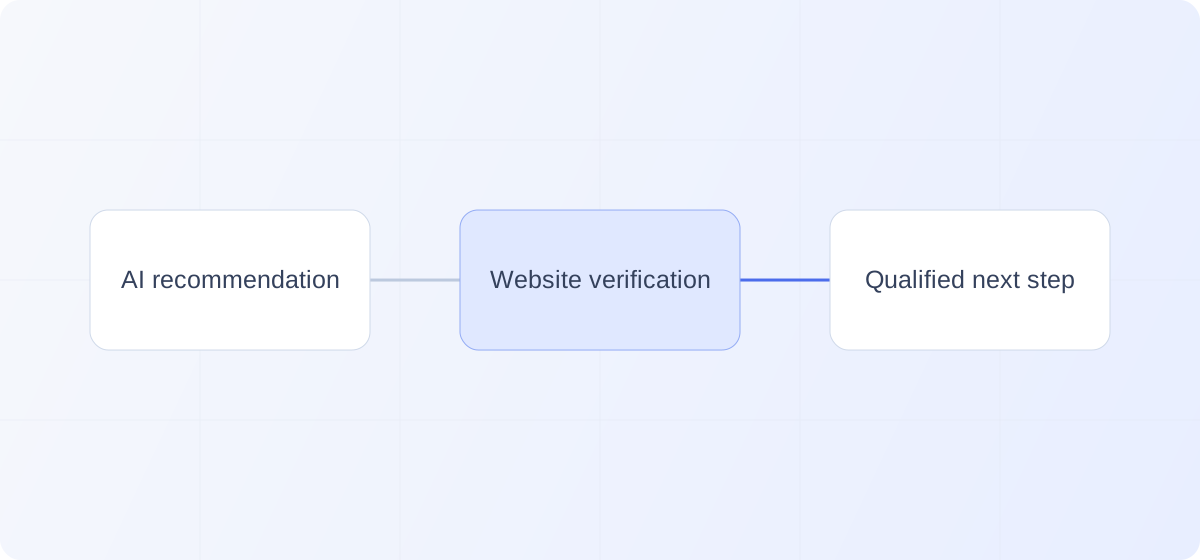
Getting recommended by an AI search engine creates an opportunity. It does not finish the sale.
Consider a fictional prospect researching billing platforms. They ask an AI assistant for products that support annual contracts with usage-based charges. Your company appears on the shortlist.
They arrive at your website with a particular question:
“Can we bill customers annually for a committed allowance and charge separately when they exceed it?”
They have already encountered your name, a description of your product, and a reason to investigate.
Your website now has to establish whether that reason holds up.
A generic introduction to billing automation will not resolve the question. Neither will an enthusiastic response that treats every form of usage-based billing as equivalent.
The prospect needs to understand whether your product supports their actual workflow.
Converting AI search traffic into B2B pipeline means helping prospects verify what they have learned, establish fit, and take an appropriate next step. Visibility creates the introduction. Your website still has to earn the opportunity.
The visitor may be further into research than into a purchase
AI-assisted research is already part of some B2B evaluations.
In findings published in May 2026, Gartner reported that 45% of 645 surveyed B2B buyers had used generative AI during a recent purchase, primarily to gather information about vendors and products. The survey was conducted in August and September 2025. It also found that 69% preferred to validate AI-generated insights with sales representatives.
That describes a more nuanced opportunity than “AI sends better leads.”
A prospect can know the terminology, recognize several vendors, and have a comparison table without having established a budget or agreed internally to buy anything.
They may be informed, interested, and unqualified at the same time.
Your website should respect the research without making assumptions about commercial readiness.
Someone who has already developed a detailed requirement should not have to repeat a generic introduction. Someone who is learning about the category should not be pushed into scheduling because their referral source looks promising.
Start with what they are trying to determine.
The useful question is:
“What would this need to do for your team?”
That invites context without requiring the prospect to recount their entire research history.
The recommendation and the verification are different jobs
An external AI assistant can help a prospect explore a category and assemble options. Your business is responsible for accurately explaining what your product actually supports.
Those responsibilities should remain distinct.
Google describes AI Mode as supporting nuanced questions and complex comparisons. Its AI search features can issue several related searches across topics and sources when producing a response. That means the information preceding a website visit may have been assembled from more than one page or publisher.
The resulting recommendation may be useful. It may also be broader than the prospect’s actual requirement.
Return to the billing example.
“Supports usage-based pricing” could be accurate while leaving open whether annual commitments, overages, credits, and invoicing timing work the way the prospect expects.
Your job is to make the boundary clear.
For a fictional product, an appropriate response might be:
“We support monthly usage billing. Annual commitments with overage charges require a separate configuration. Are you looking to invoice the overage monthly or at the end of the contract?”
That answer should only be given if the underlying facts are approved and current. If the product does not support the requirement, say so. If the answer needs technical review, preserve the question and involve someone who can resolve it.
Being recommended is not permission to agree with the recommendation.
The same standard applies to a human representative and an AI Rep. Another confident answer does not help the prospect unless it is grounded in evidence.
Help the prospect inspect the claim
A website prepared for AI-referred prospects should make important product claims easy to verify.
That does not mean creating a special landing page for every possible prompt. It means giving material claims enough context to survive investigation.
An integration page should explain what the connection does. A pricing page should distinguish the starting price from a quote for a particular configuration. A capability description should identify important requirements and limitations.
Use a simple test:
“Could a prospect tell exactly what we mean, and find the evidence, without booking a call to decode the sentence?”
For the billing platform, “Flexible monetization for any business model” is difficult to evaluate.
A clear explanation of supported billing schedules, usage calculations, and contract structures gives the prospect something concrete to compare with their requirement.
Make those details accessible from the relevant page. A prospect checking a specific capability should not have to reconstruct the answer from a launch announcement, an old help article, and a pricing footnote.
Where a demonstration is useful, show the relevant workflow. Where a document is restricted, explain what can be shared and how to request it.
The website should make verification easier, not turn it into a scavenger hunt.
Handle the expectation gap without making the prospect feel wrong
A prospect may arrive with an understanding that differs from your current offering.
The discrepancy can have several causes. They may have read an old source, misunderstood a qualification, or received a summary that omitted a limitation.
You do not need to diagnose the cause before helping them.
Start by establishing what they understood.
“What were you expecting the annual commitment to include?”
Then explain the current position in plain language.
There are three useful outcomes.
The expectation is correct. Confirm it, provide the relevant detail, and continue from there.
The expectation is partly correct. Explain the condition that matters. The feature may require a particular plan, configuration, or connected system.
The expectation is unsupported. Correct it directly. Do not leave a prospect believing a necessary capability exists because the misunderstanding makes the conversation easier.
For an AI Rep, this is a particularly important instruction. The visitor’s description of what another system said is evidence of their expectation. It is not an approved source of product truth.
Do not blame the prospect for researching independently. Do not disparage the system that recommended you. Resolve the difference and help them decide whether the product is still worth evaluating.
An honest correction can end an unsuitable evaluation earlier. That is preferable to discovering the same mismatch after several meetings.
You do not inherit the conversation they had elsewhere
A referral can tell you something about where a visit originated. It does not tell you everything the person asked, read, or believed before arriving.
OpenAI’s publisher guidance says ChatGPT includes utm_source=chatgpt.com in referral URLs. That can help identify attributed visits in website analytics. The parameter is a source marker, not a transcript of the person’s conversation or a qualification record.
Build the experience around that limitation.
Do not greet a visitor as though you know the private requirements they discussed elsewhere. Do not assume their budget, preferred competitor, or stage of evaluation from the source alone.
Give them an easy way to provide the relevant context voluntarily.
“What are you comparing or trying to confirm?”
They can explain a requirement, paste a non-sensitive claim, or ask their question directly. There is no need to request an entire private research conversation.
Also, avoid requiring prospects to declare which AI product they used. Some will arrive through another route after researching with AI. Others will not remember the exact sequence.
The information that matters most is what they need to determine now.
Use discrepancies to improve what the market can learn about you
Suppose several prospects arrive believing a feature is included in every plan.
Treat that as something to investigate.
Check your own pages first. A broad statement on the homepage may be technically qualified on the pricing page but still leave an unclear overall impression.
Look for old announcements that no longer describe the current product. Check whether integration summaries omit important constraints. Make sure the information used by your website AI Rep agrees with the approved public facts.
Where an external source is wrong, request a correction when practical. Keep a record of what was inaccurate and where it appeared.
Do not promise that updating a page will immediately change every generated answer.
Google’s guidance says there is no special schema or machine-readable file required for inclusion in its AI search features, and meeting its requirements does not guarantee indexing or serving. The foundation remains accessible, useful, reliable content.
Your objective is to make the correct explanation easy to find and difficult to misunderstand.
That benefits the prospect who reads the page directly and the systems that may use it as a source.
Give the next meeting a reason beyond “they came from AI”
Once the prospect’s requirement is understood, choose the next step on its merits.
In the billing example, a meeting may be worthwhile because the prospect has a specific contract model, a supported use case, and an implementation question that deserves a specialist.
The AI referral explains how they discovered the company. It does not replace those reasons.
If a meeting is appropriate, preserve what needs to be verified.
A useful handoff would explain that the prospect is evaluating annual commitments with monthly overages, what has been confirmed, and what remains unresolved.
It should not simply say:
“High-intent ChatGPT lead.”
That label sounds valuable while telling the next person very little.
The first sales conversation should continue the evaluation the prospect has already started.
Review the journey from the recommendation forward
Choose one commercially important question and investigate the experience it produces.
What do external answers say about your product? Which page does a cited link open? Can someone verify the important claim there? What happens when they ask for clarification?
This is an editorial and experience review, not a way to control every recommendation.
Look for specific failures you can correct: an unsupported claim, a missing condition, an outdated price reference, or a conversation that restarts the evaluation unnecessarily.
As results arrive, connect known referral sources with the questions prospects ask and the opportunities your team accepts. Keep the limits of attribution visible.
Do not declare success because a brand mention appeared in an answer. Do not declare failure because a small referral cohort has not yet produced a deal.
The valuable finding is more specific:
“Prospects arriving with this requirement can now establish fit and reach the right next step.”
That is an improvement your business can act on.
Frequently asked questions
Are prospects referred by AI search automatically higher intent?
No. A referral identifies a discovery path, not a purchase decision. Establish the prospect’s use case, fit, and readiness through the information available and what they choose to share.
Should an AI Rep accept the claims a prospect brings from another AI system?
No. Treat those claims as context about the prospect’s expectations. Verify product information against approved sources, explain limitations, and escalate material uncertainty.
Does improving AI visibility remove the need for a useful website?
No. A recommendation can lead someone to investigate. The website still needs to help them verify capabilities, understand terms, resolve questions, and decide whether to continue.
Earn the confidence the recommendation borrowed
At Kassie, we focus on what happens when a prospect reaches a B2B tech website: answering questions from approved business knowledge, understanding fit, and helping suitable prospects book with the sales team.
AI search adds another route into that experience. It also adds another reason to take accuracy and context seriously.
The prospect may arrive with a favorable impression you did not create directly. They may also arrive with expectations you need to clarify.
Help them establish what is true, what applies to their business, and what happens next.
A recommendation gives your product a place in the conversation. Your website has to justify keeping it there.