
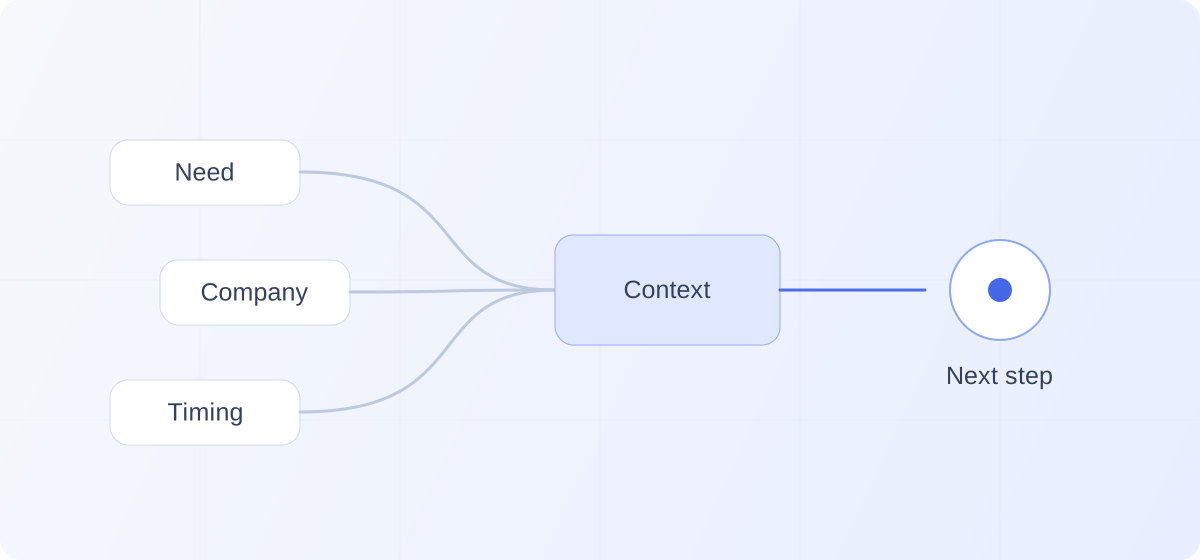
TL;DR: To qualify website visitors in real time, learn enough to judge fit and decide where the conversation goes, without necessarily mapping the full purchasing process first. Answer the prospect’s question before asking another, treat missing information as unknown rather than negative, give uncertain cases a defined path, and stop once the next step is clear.
A prospect tells you what they need.
Your website asks how many employees they have.
The question might matter eventually. But if the response ignores what the prospect just said, qualification has already started working against the conversation.
Real-time website qualification means using a prospect’s questions, stated needs, and relevant context to determine whether your business can help them and what should happen next, while they are still on the site.
Done well, the prospect gets a clearer understanding of the product. Your team gets a clearer understanding of the prospect.
The work should feel useful to both sides.
That requires deciding which information matters, when to ask for it, and when you already know enough to move forward.
Start with the decision, then choose the questions
Before writing a qualification script, agree on the decision it needs to support.
For many B2B companies, the immediate decision is whether a conversation with a sales representative would be useful.
That is a smaller question than whether the prospect will ultimately become a customer.
You need enough information to establish a relevant use case, identify important constraints, and choose an appropriate next step. You do not necessarily need the full purchasing process mapped before offering an initial meeting.
Define the characteristics of an ideal customer, including their goals, industry, company size, and product requirements. Intercom’s conversational-qualification guidance recommends collecting only information that helps the team understand the prospect and assess fit.
Translate those characteristics into decisions your website can make.
A useful starting point is to separate your requirements into four groups:
| Type of information | Example | How to use it |
|---|---|---|
| Necessary before booking | Whether the prospect needs a use case your product supports | Establish it before offering the relevant sales path |
| Helpful for the meeting | Current workflow or preferred implementation timing | Capture it when available without making every detail a barrier |
| A genuine disqualifier | A mandatory deployment model you do not offer | Explain the limitation before encouraging further evaluation |
| Something requiring review | A technical requirement not covered by approved information | Preserve the question and involve someone who can assess it |
This is a working structure, not a universal qualification standard. Your product and sales process determine what belongs in each group.
The distinction prevents two different mistakes: booking people you cannot help, and blocking useful conversations because a nonessential field is empty.
Every required question should have a clear answer to: what decision changes when we know this?
If nobody can explain why the information is required before booking, reconsider whether it belongs there.
Answer the question that brought the prospect to you
A prospect asking about your product has given you a starting point.
Use it.
If they ask whether a particular capability exists, answer from the information your business has approved. If the answer depends on their circumstances, ask the clarification needed to make it useful.
That establishes a natural reason for the conversation to continue.
Intercom’s guidance for conversational qualification recommends answering a lead’s question before asking another, avoiding repeated questions, and making the benefit of providing information clear.
Consider the difference between:
“What is your company size?”
and:
“Will this be used by one team or across several departments? That affects which setup would fit.”
The second question explains its purpose. It also asks about the scale relevant to the product rather than assuming total employee count tells the whole story.
Company size may still matter. But choose the question that helps resolve the prospect’s situation.
Do not withhold a straightforward answer to create an opportunity for discovery. Someone asking about a supported integration should not need to disclose their budget before learning whether it exists.
A useful answer earns the next question.
Ask the next necessary question, not the next scripted one
A qualification script can keep a team consistent. It becomes a problem when the sequence matters more than the information already available.
Suppose your prospect says:
“We’re evaluating this for our finance team because our current process takes too long at month-end.”
You already know the department, the broad use case, and a reason for investigating.
Asking “What brings you here today?” adds nothing.
A better follow-up would investigate the part that changes your understanding:
“Which part of month-end is taking the most time?”
Their answer may reveal a problem you solve well. It may reveal a requirement outside your scope.
Either way, the conversation progresses.
Use the same discipline with urgency. If someone mentions a contract renewal in November, preserve that context. Do not ask them to select a buying timeline from a menu immediately afterward.
There is also no requirement to attach a question to every answer.
Sometimes the prospect needs time to read, compare, or ask the next thing on their mind. A conversation that ends every response with another qualification question can feel relentless, even when each question is individually reasonable.
The judgment is in choosing when more information would help.
What a useful qualification conversation looks like
Consider a fictional reporting platform built for agencies. In this example, the product supports Google Ads and Meta reporting, and its sales team accepts evaluation meetings without requiring a pre-approved budget.
A prospect begins:
Prospect: Can we send separate reports to each client automatically?
AI SDR: Yes. You can schedule a separate report for each client. Which advertising platforms do the reports need to cover?
Prospect: Google Ads and Meta. We manage 30 clients and spend every Friday putting their reports together.
AI SDR: Both are supported. Are you replacing an existing reporting platform, or assembling the reports manually?
Prospect: Manually, in spreadsheets. I’m comparing options for our head of performance. We’d like to change that next month.
AI SDR: It would be useful to see how the scheduled reports would handle that weekly process. Would you like a walkthrough with our team using sample data?
The prospect received an answer to the original question.
The conversation also established a relevant customer type, supported data sources, the scale of the workflow, an existing problem, the contact’s role in the evaluation, and a desired timeframe.
Those details emerged because each question followed the situation.
The prospect did not have to complete a miniature procurement interview to earn a meeting.
There are still things the sales team needs to learn. What exactly must the reports contain? Who else will evaluate the product? Does the commercial model work for the agency?
For this fictional company’s qualification standard, those are reasonable subjects for the next conversation.
The website’s job was to establish a good reason to have it.
Do not confuse missing information with a negative answer
“Budget not discussed” and “cannot afford the product” are different facts.
So are “not the final approver” and “cannot help the purchase move forward.”
HubSpot’s budget-qualification guidance recommends establishing the value of an investment before relying on a prospect’s stated budget. The contact who first engages may also differ from the final decision-maker.
Your website should preserve those distinctions.
An evaluator might be researching on behalf of an executive. A team might need to understand pricing before requesting budget. A prospect might have a relevant problem without having decided on an implementation date.
None of those situations automatically justifies booking. None automatically justifies rejection, either.
Set a policy based on what your sales team is prepared to work.
If a minimum annual commitment determines whether further evaluation makes sense, explain the published commercial model accurately and establish whether it is within consideration. Do not demand an exact budget figure when a broad understanding would resolve the issue.
If a requirement is unknown, keep it unknown until there is evidence.
Similarly, do not treat a personal email address as proof that the company is a poor fit. It may mean you need more context or verification before taking a particular action.
An empty field should describe what you have not learned, not a conclusion you invented.
Give uncertainty its own next step
A qualification system needs more than two outcomes.
“Book a meeting” and “reject” leave little room for the prospect who seems relevant but has an unresolved requirement.
Decide what happens in that middle ground.
Perhaps a product specialist should review the question. Perhaps the prospect needs a particular document. Perhaps there is enough fit for an exploratory meeting, provided the unresolved issue is made explicit.
Also distinguish an unknown fact about the prospect from an unknown fact about your product.
If the prospect has not explained a requirement, ask.
If your approved materials do not establish whether the product meets it, do not improvise an answer.
And if the product definitely cannot meet an essential requirement, say so clearly.
For example:
“We don’t currently offer an on-premises deployment. If that is mandatory for your team, this would not be a fit.”
There is no need to turn that into a hard sell for the cloud version.
If the prospect says the requirement is flexible, continue from that new information. If it is not, respect the boundary.
The same care applies when a conversation stops. A prospect leaving before qualification is complete has not necessarily been disqualified. They may have been interrupted, received the answer they needed, or chosen not to continue.
Record the incomplete state honestly. Any later follow-up needs an appropriate contact method and a reason to happen.
Stop qualifying when the next step is clear
Qualification needs a stopping rule.
Without one, an automated conversation can keep asking because there is always another field to populate.
Consider someone who says:
“We’ve reviewed your documentation. We need the enterprise plan for a use case you support, and we’d like to discuss implementation.”
Check whatever genuinely determines routing and eligibility. Then help them proceed.
Do not make them repeat the entire evaluation.
At the other end, someone who says they are only looking for a public document may not need a sales conversation at all. Give them the document where appropriate.
Your process should support several legitimate outcomes: a sales meeting, further self-directed evaluation, specialist review, customer support, or an honest explanation of poor fit.
Scheduling platforms already reflect this broader approach. Calendly documents booking routes, screening routes, and fallback routes for people who do not match the configured booking or screening criteria.
A conversational experience needs equally deliberate destinations.
The ability to ask another question is not a reason to ask it.
Make the decision actionable
A qualification result should lead somewhere real.
If the next step is a meeting, the appropriate calendar needs to be connected and available. If a specialist must review the request, someone needs to own it. If the visitor needs support, the support path needs to work.
A well-worded promise does not complete the action.
Intercom’s sales-agent documentation makes this distinction explicit: conversational guidance controls how the agent communicates, while routing conditions, required information, integrations, and workflow actions determine what it can actually do.
Apply that principle regardless of the product you use.
Test what happens after the conversation reaches a decision. Verify that a booking completes, a handoff reaches its owner, and an exception does not leave the prospect at a dead end.
Preserve the reason for the next step, too.
For the fictional agency example, a useful handoff might read:
Agency managing 30 clients. Reporting across Google Ads and Meta is currently assembled manually in spreadsheets each Friday. Contact is evaluating options for the head of performance and would like to change the process next month. Interested in a walkthrough of scheduled client reporting. Budget and final approval process have not been discussed.
That summary gives the next person a productive place to begin.
It also makes the limits clear. “Would like to change the process next month” is not the same as a committed purchase date. An evaluator is not automatically the budget owner.
Good qualification leaves a record of what is known, what remains open, and why the next conversation makes sense.
Test who the process lets through and who it turns away
Testing an easy, ideal prospect is only the beginning.
Before deploying a qualification flow, try the situations where judgment matters.
Use a relevant prospect who does not know the budget. A highly engaged prospect with an unsupported requirement. An existing customer asking for help. Someone ready to book immediately. Someone who supplies contradictory information. Someone whose technical question requires review.
For each scenario, decide what an appropriate response and outcome would look like before running the test.
Then examine both the conversation and the resulting action.
Did it answer accurately? Ask only what was needed? Respect the prospect’s readiness? Preserve uncertainty? Connect them to the intended destination?
Continue that review after deployment.
Look at meetings the sales team accepted, meetings it rejected, and a sample of conversations that never reached booking. Otherwise, you learn only from the people your process allowed through.
Record reasons in a way your team can revisit. HubSpot, for example, provides a customizable disqualification-reason property for lead records. The usefulness comes from choosing specific reasons and applying them consistently.
A meeting rejected because the product lacks a required capability points to a different issue from one rejected because the prospect is researching a later initiative.
If unsuitable prospects repeatedly get booked, revisit the criteria or how the conversation applies them.
If suitable prospects repeatedly leave while answering unnecessary questions, revisit the burden you have created.
The goal is to improve judgment in both directions.
Frequently asked questions
How many questions should website qualification require?
There is no universal number. Ask what is necessary to establish fit and choose the next step, accounting for information the prospect has already shared. Some conversations need one clarification. Others need more. Stop when additional questions would not change the immediate decision.
Should qualification require an approved budget?
Only when that is genuinely necessary for the next step your business offers. A prospect may need to evaluate a product before securing approval. Distinguish an unknown budget from a confirmed mismatch, and make your pricing clear enough for an informed conversation.
Can an existing form qualify visitors in real time?
Yes. Forms can collect information, apply rules, and present an appropriate booking path. A conversation adds the ability to clarify answers, explore context, and help prospects understand the product while fit is being established. Choose the experience that serves the situation rather than replacing a working form for its own sake.
What should happen when the AI cannot determine fit?
Preserve the uncertainty and use a defined fallback, such as a relevant clarification or human review. Do not invent missing information or automatically reject the prospect. The correct outcome depends on what is unknown and how important it is to the decision.
Make the next conversation worth having
Kassie uses a company’s ideal customer profile, required qualification criteria, approved product knowledge, and prospects’ answers to assess fit during website conversations. Qualified prospects can book with the sales team inside the conversation.
The standard is a useful exchange that leaves both sides better informed.
Your prospect should understand whether the product can help and why the next step is worthwhile. Your team should understand the situation well enough to continue without starting over.
That is what real-time qualification should accomplish.
The prospect’s attention is already on your business. Use it to understand them, help them, and make a sound decision together.