
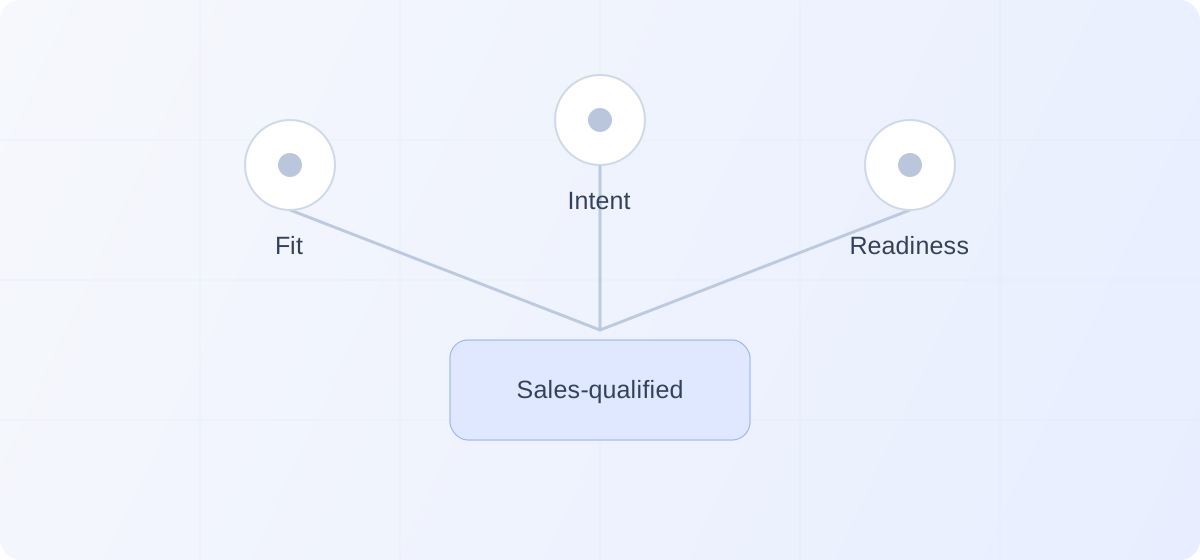
TL;DR: A website visitor is sales-qualified when evidence, judged against your company’s criteria, justifies active sales attention. Check whether your product meets their essential requirements, they have a meaningful reason to consider changing, and they want an appropriate next step. Engagement, demo requests, and company fit only justify investigation. Opportunity criteria, not bookings, define pipeline.
A sales-qualified prospect has been evaluated against your company’s criteria and shown enough relevant interest to justify moving into the sales process. On a B2B website, that means establishing whether the prospect’s business, needs, and readiness support a useful commercial next step. Visiting a page or submitting contact information begins that assessment; it does not complete it.
That distinction sounds straightforward until someone asks:
“How many qualified prospects did the website generate?”
One person counts demo requests. Another counts conversations from companies in the target market. A third counts only prospects a representative has spoken with.
They are answering different questions with the same number.
Before you improve website qualification, establish what the label allows your team to conclude.
“Sales-qualified” should mean there is a reason to pursue the prospect that another person can understand and evaluate.
A familiar company profile is only the beginning
A prospect works at the right kind of company. Their title looks relevant. Their organization has enough employees to match your target market.
That establishes a reason to pay attention.
It does not establish what they need.
A company that looks like your best customer might require a capability you do not offer. Another might have the problem you solve but no interest in changing how it handles the work.
Keep company fit and engagement separate as you investigate.
HubSpot’s lead-scoring system makes this distinction explicit: fit scores evaluate record attributes, while engagement scores evaluate actions. It also allows combined scores while preserving separate fit and engagement values.
That separation is useful because neither dimension can answer the whole question.
Repeated pricing-page visits suggest something worth understanding. They do not tell you whether the prospect can use the product.
A perfect company profile suggests potential relevance. It does not tell you whether a purchase is under consideration.
For website qualification, use these signals to decide where more understanding is needed.
Then look for evidence of a commercial situation your business can actually serve.
Three promising visits can mean three different things
Consider three fictional prospects visiting the website of a cloud-security platform.
All work at B2B tech companies within its target employee range. All view product information and pricing. All ask a question.
From a distance, the visits look similarly promising.
A relevant person researching the category
A security leader says:
“We’re updating our internal view of this category. Nothing is changing this year, but I want to understand how the products differ.”
There is professional relevance and genuine curiosity.
There is no stated evaluation project or request for a sales conversation.
Help them understand the category. Provide useful information. Leave room for them to explain whether there is a more immediate need.
Under a qualification standard focused on active evaluations, this person is not yet sales-qualified.
That does not make the visit worthless. It means the appropriate relationship is different from an active sales opportunity.
An evaluator with a specific assignment
A platform engineer says:
“Our CTO asked me to compare three options before our current contract renews. We need to cover AWS and Azure, and I’d like someone to walk through how your deployment works.”
Assume this fictional product supports those requirements.
The engineer has a relevant assignment, a defined use case, a reason for evaluating now, and a useful next step.
They are not the final approver. That fact should be recorded. It does not erase the commercial context they just provided.
If the company’s qualification policy accepts technical evaluators with an active project, this prospect meets a meaningful threshold for sales engagement.
An enthusiastic prospect the product cannot serve
A CTO says:
“We need to deploy next month. We have budget and can make a decision quickly. Our environment is entirely on-premises.”
Assume the platform supports only public-cloud environments.
The seniority, budget, and urgency are attractive. The product mismatch is decisive.
Booking a meeting without addressing that limitation would pass a known problem to the next person.
The three visits show why engagement alone is insufficient. The second prospect has a credible reason to proceed. The first needs a different kind of help. The third needs a clear explanation of the limitation.
Qualification depends on the situation behind the visit.
What needs to be true before a prospect is sales-qualified?
For website conversations, we recommend a working standard built around three questions.
Can your product help with the situation they describe?
Fit should account for the actual work the prospect needs done.
Industry and company size can help establish context. Product requirements determine whether your business can serve the use case.
A mandatory integration, deployment requirement, supported region, or operating constraint may matter more than a familiar job title.
You do not need to resolve every implementation detail on the website. You do need to recognize known barriers and preserve questions that require review.
If an essential requirement is unsupported, say so. If support is uncertain, keep that uncertainty visible.
Is there a meaningful reason to evaluate a change?
Look for the prospect’s explanation of what they are trying to accomplish.
They might be replacing an existing product, supporting a new initiative, reducing a costly manual process, or solving a problem their current approach cannot handle.
The situation does not need to be a crisis. An improvement can be commercially worthwhile without someone describing it as urgent or painful.
But it should connect to something more specific than a general interest in new technology.
Consider the difference between:
“Your product looks interesting.”
and:
“We need to reduce the time our team spends reconciling these records before the next reporting cycle.”
The second statement provides a reason to investigate fit. It also gives the next conversation a purpose.
Is there an appropriate next step the prospect is prepared to take?
Readiness should be judged against the next action, not an imagined signature.
A prospect might be ready for a technical discussion, an evaluation walkthrough, or a commercial conversation. They may not yet be ready to buy.
Establish why that next step would help and whether the prospect wants it.
A person accepting a calendar invitation is useful evidence of willingness to meet. The reason for the meeting still matters.
Someone taking a call out of curiosity or courtesy should not automatically receive the same status as someone evaluating the product for a defined business need.
The threshold is enough grounded context to justify active sales attention.
Qualification is not completed procurement
Budget, authority, need, and timing are established qualification considerations, commonly grouped in the BANT framework. Salesforce includes them among the factors used to assess whether a prospect is ready to progress.
The practical question is how much must be established before the next step your business offers.
Our recommendation is to distinguish qualification for an initial evaluation from qualification for a forecasted purchase.
An evaluator may need to understand the product before requesting budget. A department leader may have a clear problem but need help developing the internal case. A technical contact may be responsible for selecting options while another person approves expenditure.
Treat those circumstances accurately.
“Budget not established” is different from “the prospect has confirmed they cannot afford the product.”
“Evaluating on behalf of the CTO” is different from “no connection to a purchasing process.”
Those distinctions should affect the next step. They should not disappear inside a generic qualified-or-unqualified field.
For some businesses, an initial meeting is exactly where financial and organizational fit become clearer. Others need stricter screening because evaluation requires substantial technical work.
Choose the standard deliberately. Make it understandable to the people and systems applying it.
The prospect does not need to finish your sales process before being allowed to start it.
Know what each label actually represents
A website visitor, a lead, and an opportunity are different things.
HubSpot’s default lifecycle stages distinguish marketing qualification, sales qualification, and association with a deal. The stages can also be customized to reflect a company’s process.
For a website-to-pipeline workflow, the following distinctions are useful:
| Term | What it tells you |
|---|---|
| Website visitor | Someone accessed the site. Their identity, fit, and purpose may be unknown. |
| Lead | A contact or company has entered a trackable relationship through an inquiry or other interaction. |
| Marketing-qualified lead, or MQL | Marketing has assessed the lead against its agreed handoff criteria. |
| Sales-qualified lead, or SQL | The prospect meets the sales team’s criteria for active pursuit. |
| Opportunity | A specific potential deal has been opened under the company’s opportunity-creation criteria. |
These labels organize work. They should not force every prospect through an identical journey.
A referred prospect may arrive with a clear project. Another may spend time learning before discussing a purchase.
Product-led businesses add another useful concept: the product-qualified lead, or PQL. ProductLed defines a PQL around experiencing meaningful value in the product, rather than simply signing up or engaging with marketing. The relevant behaviors depend on the product and should be assessed against actual customer outcomes.
That is another source of qualification evidence, not a required stage for every company.
Use the terminology your organization needs. Make sure each label has a distinct meaning and a corresponding action.
A lead score should be explainable
Scoring can help prioritize records and apply criteria consistently.
But a number inherits the assumptions behind it.
Imagine a scoring model that awards points for pricing-page visits, content downloads, and company size. An unsuitable prospect could accumulate a high score through activity without meeting an essential product requirement.
The model has identified engagement. It has not resolved the mismatch.
Keep genuine disqualifiers separate from signals that indicate interest. Do not allow enough page views to override a requirement the product cannot meet.
Also make the evidence behind a qualification decision easy to inspect.
Compare these two records:
“Qualified. Score: 85.”
and:
“Evaluating a supported use case ahead of an existing contract renewal. Technical evaluator assigned by the CTO. Requested a deployment walkthrough. Final budget approval remains open.”
The second explains why a conversation is worth having and where uncertainty remains.
A score can help locate that record. The context helps someone act on it.
The same standard should apply to AI-generated assessments. An authoritative-sounding summary is not a substitute for supporting evidence.
Preserve what the prospect actually shared. Distinguish it from inference. When new information changes the assessment, update the decision rather than defending the original label.
A meeting is an action. Pipeline requires a deal.
A qualified prospect booking a meeting is meaningful progress.
It does not automatically establish a specific amount of pipeline.
Set an explicit threshold for creating an opportunity. Decide what must be known about the potential purchase and who or what is authorized to create the record.
That threshold may be reached during the website conversation. It may require further discovery afterward. The calendar event alone should not supply missing commercial evidence.
Consider a fictional prospect who appears to fit your product, explains a relevant initiative, and books a walkthrough. The meeting may confirm a viable project. It may also reveal that a mandatory requirement cannot be met.
The website can have done a good job identifying a worthwhile conversation even when deeper evaluation ends the deal.
What would be misleading is presenting every initial booking as confirmed pipeline before applying the company’s opportunity standard.
Keep the accounting of progress honest.
Several people from one company can also participate in the same evaluation. Their conversations may strengthen your understanding without creating several separate purchases.
Count the commercial opportunity, not every interaction around it.
Test whether your definition works in practice
A written definition is useful only if people apply it consistently.
Take a small set of recent website inquiries and ask the relevant team members to assess them independently.
Which are ready for sales? Which need more information? Which should receive help without becoming active opportunities?
Then compare the reasons.
If one person qualifies a prospect because of company size while another rejects them because of an unsupported requirement, the disagreement exposes an unclear rule.
If everyone agrees a prospect is qualified but nobody can explain the reason for the next meeting, the definition may be too loose.
Look beyond bookings as you refine it.
Review the opportunities sales accepted, the conversations sales declined, and examples that never reached a meeting. Later, examine whether customers from those paths were actually successful with the product.
Do not tighten the criteria merely to improve a conversion percentage. Rejecting more prospects can make a rate look better while excluding worthwhile opportunities.
And do not loosen the definition to make the website appear more productive.
The goal is a consistent judgment that directs attention toward prospects your business can help.
Frequently asked questions
Does visiting the pricing page make someone sales-qualified?
No. It is a reason to investigate interest, not a complete qualification decision. You still need enough context about the prospect’s fit, needs, and readiness to determine whether active sales engagement makes sense.
Is every demo request a qualified lead?
No. A request expresses interest in a demonstration. The prospect may still have an unsupported use case or another important mismatch. Make it easy to book where appropriate, while applying the criteria necessary to ensure the meeting is useful.
Does a prospect need to be the final decision-maker?
That depends on the purpose of the next conversation. An assigned evaluator or influential stakeholder may provide a credible path into a real purchasing process. Record their role accurately and identify what remains unknown about approval.
Can AI determine whether a website visitor is sales-qualified?
AI can help gather relevant context and apply defined qualification criteria. Its assessment should remain traceable to the conversation and other permitted evidence. Configure a review path for unresolved requirements, and do not treat confidence in the wording as proof that the conclusion is correct.
Is a sales-qualified lead the same as pipeline?
Not automatically. Sales qualification establishes that a prospect is worth pursuing under your criteria. Pipeline should represent specific potential deals that meet your opportunity-creation standard. Keep the two definitions clear even when they occur close together.
Make qualification mean something
Kassie assesses website prospects using the company’s ideal customer profile, required qualification criteria, approved product knowledge, and the answers shared during the conversation. Qualified prospects can book with the sales team inside that experience.
The purpose is to make the next interaction better informed.
Your team should know why the prospect is relevant, what they are trying to accomplish, and which questions remain open. Your prospect should understand why continuing is worth their time.
When someone asks how much qualified demand the website produced, you should be able to explain the opportunities behind the number.
Sales-qualified should mean you have a reason to continue, and enough evidence to explain why.