
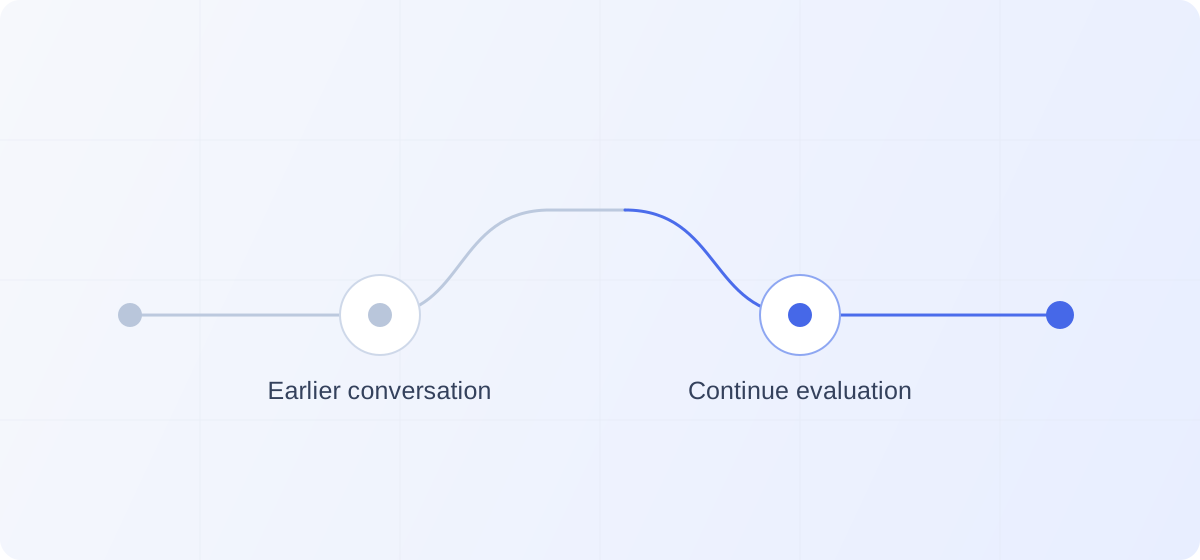
The first conversation makes a tidy demonstration. A visitor arrives, asks a question, explains their needs, and books a meeting. Everything moves neatly from introduction to next step.
Now consider the return visit.
The prospect has attended discovery. Their colleague has reviewed the proposal. Someone in IT has raised a deployment question. They come back to the website to check one detail before an internal meeting.
The agent asks what their company does.
It is a small moment with a large message: the business has forgotten the conversation the buyer is still having.
For B2B inbound sales, continuity means carrying the relevant, permitted context into the next interaction. An AI sales agent should be able to help a returning buyer make progress while checking what has changed, respecting account ownership, and protecting information the visitor is not entitled to receive.
That requires more judgment than recognizing an email address and saying welcome back.
The same question changes meaning
Consider a fictional company buying an operations platform. Maya, its operations director, asks the website agent whether she can roll out the product one department at a time.
On the first visit, the question is about product fit. A useful answer explains the supported rollout model and asks what constraint makes a phased deployment important.
A week later, Maya returns. Discovery is complete. The account executive has identified an implementation specialist, and Maya’s team is trying to settle a launch date. She asks about a phased rollout again.
The words are familiar. The decision has changed.
Maya may now need to know whether the proposed sequence fits her team’s staffing and deadline. Repeating the general product answer might be accurate and still leave her stuck. Offering another introductory demo would make the company look thoroughly unfamiliar with its own sales process.
After verifying Maya’s identity and the context she is authorized to access, the agent could acknowledge that she is working through a rollout plan and ask which part still needs clarification. It can answer approved product questions and send the account owner any request that changes the proposed commitment.
If the approved proposal specifies a one-department first phase, a useful continuation might be: “The proposed rollout starts with one department. Are you checking whether the others can join later, or whether your team has enough capacity to run the first phase?” The answer would help distinguish a product question from an implementation concern.
The point is to start at the decision Maya is making now. Good initial qualification helps a conversation begin. Continuity helps the evaluation continue.
Keep a small, current account of what matters
Giving an agent every message ever exchanged with an account is an expensive way to avoid deciding what is relevant.
A sales conversation needs a usable account of the current situation. That might include the buyer’s stated objective, confirmed requirements, unresolved questions, the responsible salesperson, and the next action already agreed.
Each item should have enough context to be interpreted correctly.
| Information to preserve | Detail that keeps it useful |
|---|---|
| Buyer’s objective | Who stated it, when, and whether it still applies |
| Product requirement | Confirmed need, tentative preference, or inference awaiting confirmation |
| Unresolved question | What remains unanswered and who owns the response |
| Commercial discussion | Approved scope, effective dates, and limits on who may see it |
| Next action | Owner, current status, and whether it has already happened |
There is a useful technical parallel in Anthropic’s work on context engineering: agents benefit from selecting relevant information for the current task rather than carrying an ever-growing history into every interaction.
Applied to sales, this means retrieving the context needed for this buyer’s question. A long transcript containing an outdated price, a speculative deadline, and an unapproved exception can make the answer worse if the system treats all three as current facts.
Relevant memory needs a source, a status, and an owner who can correct it.
Establish who is returning before using private context
There are several different situations hidden inside the phrase “returning visitor.”
The same person may return on the same browser. A colleague may arrive from the same company. A consultant may be helping the company evaluate vendors. A visitor may simply type a company name into the conversation.
Those situations should not receive identical access to account information.
A company match can help route a request without establishing permission to reveal a proposal. A supplied email address can help locate a record without proving the visitor controls that address. A familiar browser can suggest continuity without proving who is using it today.
Set the access policy outside the conversation itself. The system should check identity and permission before retrieving restricted material for the agent, rather than relying solely on an instruction telling the model to keep certain details secret.
Public product answers can remain easy to access. Account-specific terms, internal deal notes, and other people’s conversations need a more controlled path.
If identity is uncertain, the agent can still answer general questions, explain how to continue securely, or offer to connect the visitor with their account team. It should avoid revealing that a particular person is negotiating a purchase merely because a stranger knows their company name.
Good continuity makes the buyer’s work easier without turning the website into a window onto the CRM.
Help the new stakeholder find their place
Now imagine that Maya sends the website to Daniel, an IT colleague. He has never spoken with the vendor. He asks about deployment requirements.
Daniel’s question deserves a useful technical explanation. The agent can establish whether he is evaluating independently or participating in Maya’s project without sharing her private conversations. Once his relationship to the evaluation is verified, Daniel can become another contact associated with the existing opportunity, with the account team retaining ownership. His arrival should not automatically create a second opportunity or send the account through round-robin routing again.
This is the operational side of helping a B2B buying group evaluate. Different people need different information while the vendor maintains one coherent view of the opportunity.
Recheck the facts that can change
Remembering an old answer is useful only when the answer still applies.
Since the last conversation, a meeting may have been rescheduled, a quote may have expired, a requirement may have changed, or a colleague may have already resolved the question. The buyer might also be investigating a new project at the same company.
Before proposing a consequential next step, refresh the relevant state. Check whether the appointment still exists, whether the commercial terms remain valid, and who currently owns the account.
When records conflict, preserve the conflict for resolution. A buyer’s latest statement should update the discussion without silently rewriting a signed agreement or an approved commercial decision. Likewise, an old CRM field should not overrule a clear correction from the person describing their needs.
Suppose Maya originally mentioned a January launch and now says the team is aiming for March. The system can record that updated intention and notify the account owner. It should not treat the earlier date as permanent truth or promise a March delivery without the required confirmation.
The goal is a current working understanding of the evaluation, including what remains uncertain.
Continue the existing sales motion
An active opportunity already has relationships and commitments. The website should help those relationships function.
If Maya asks for another meeting, the agent should check the existing owner and appointment context before creating something new. She may need to reschedule, add a specialist, or get an answer that makes another meeting unnecessary.
If she asks a question that requires her account executive, preserve the question and why it matters. “Please follow up” leaves the salesperson to reconstruct the problem. “Maya needs confirmation on the phased rollout before her internal planning meeting” gives the next conversation a purpose, provided that is what she actually said.
A returning buyer may also be a former opportunity or an existing customer. In those cases, determine the current need before choosing the workflow. A new project, a support request, and a renewal discussion deserve different handling.
Ownership rules should support the buyer’s progress. They should not strand somebody because their assigned rep is unavailable. Define an appropriate backup route and make the handoff visible to the account team.
Test the return journey before declaring success
Run a few realistic sequences through the experience:
- A known prospect returns after discovery with a question already answered in the approved proposal.
- A new colleague from the same company requests private pricing details.
- A buyer returns after their meeting has been rescheduled.
- A visitor corrects an earlier requirement.
- An existing customer arrives with a product problem rather than a new purchase.
For each sequence, inspect whether the agent used the right context, asked only necessary questions, respected access boundaries, and completed the appropriate next action.
Then look at the effect on the actual sales process. Are account owners receiving clearer requests? Are buyers repeating fewer settled details? Are duplicate introductions and bookings being avoided? Are unresolved questions reaching someone who can answer them?
A returning prospect helped through procurement should not automatically count as a newly sourced opportunity. Record the contribution to the existing deal without manufacturing another one.
Frequently asked questions
Should an AI sales agent remember every buyer conversation?
Keep the relevant context under an appropriate retention and access policy. A concise record of confirmed needs, unresolved issues, and agreed next steps can be more useful than a complete history of unrelated exchanges. Retained summaries still contain customer information and need appropriate protection.
Is recognizing the buyer’s company enough to share deal details?
No. Company association does not establish that a visitor may see a proposal, negotiated terms, or another person’s conversations. Verify identity and permission before making account-specific information available.
What if the agent cannot reliably identify the returning buyer?
Continue with public information and ask how the visitor would like to proceed. Provide a secure route to the existing account team when private context is needed. An uncertain match should never become a confident disclosure.
Maya returns to the website because the evaluation is still moving. The company’s job is to meet her at that point, with the context and authority appropriate to the conversation.
The best sign that the system remembers is how little she has to explain again.