
A buyer asks a specific question. Your AI SDR cannot answer it. The conversation ends, and the question joins a list nobody owns.
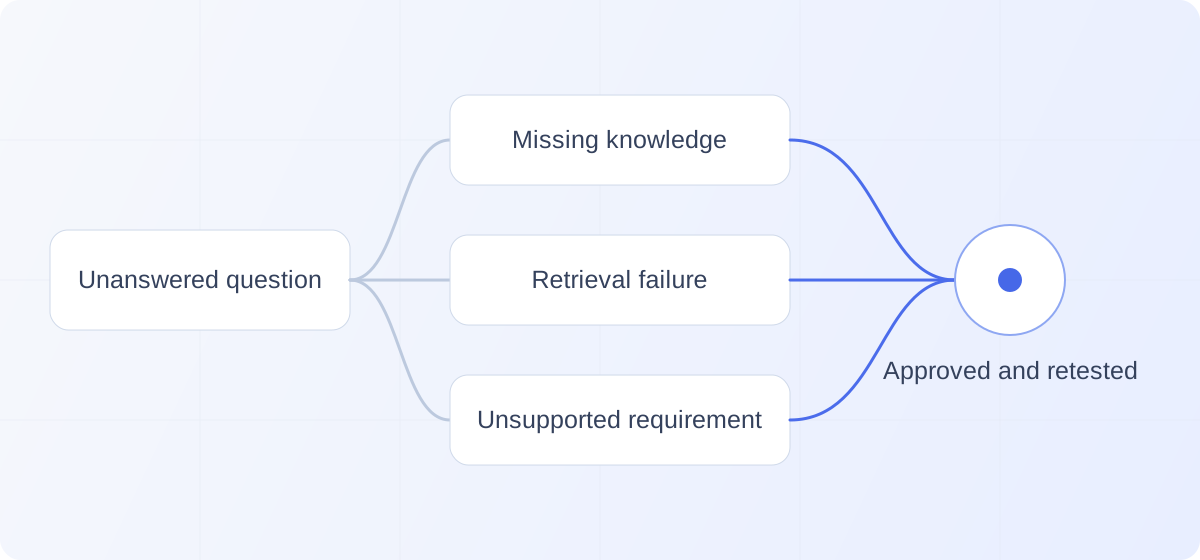
Resolve an unanswered buyer question by diagnosing it first: missing knowledge, a retrieval failure or an unsupported requirement. Have the right owner verify the facts, approve any new answer and retest it in conversation before publishing. Record unsupported requirements as product requests rather than adding answers that promise more than the product does.
An unanswered question can also expose unclear positioning or incomplete documentation. Treating every gap as a prompt to “add more knowledge” can make the next answer more confident and less accurate.
We want the questions Kassie cannot resolve to help us improve what buyers encounter next. That requires a reviewed research backlog with owners, evidence and a definition of done.
What kind of gap does an unanswered question reveal?
Start by distinguishing three situations.
Missing knowledge: The product can do what the buyer asks, and someone can verify how, but the approved material does not explain it. The work is to establish the facts and write an answer the company is prepared to stand behind.
Retrieval failure: A current, approved answer exists, but the agent did not find or use it. Adding another version can create contradictions. Investigate whether the right source was accessible, whether the buyer’s wording matched how the information was organized, and whether the agent understood the question.
Unsupported requirement: The buyer needs something the product does not do. The appropriate response is a clear limitation, followed by a supported alternative or escalation where useful. A request for a feature belongs in product discovery. It does not belong in the Knowledge Bank as a promise.
Uncertainty deserves its own temporary status while the team investigates. A confident guess would conceal the issue you need to resolve.
Clay describes a similar discipline for monty, its internal analytics agent: use approved data models and escalate questions the agent cannot responsibly answer.
Follow one integration question through the backlog
Consider this hypothetical question to a B2B software vendor:
“Can your HubSpot integration sync our custom objects, or only contacts and companies?”
The agent replies that the platform integrates with HubSpot, then offers a demo. The buyer’s actual question remains open.
The reviewer should preserve the precise question, relevant conversation context and source page. “HubSpot question” is too vague to investigate. The distinction between standard and custom objects is the reason the buyer asked.
An integration owner then verifies the product’s behavior. In this example, the connector supports contacts and companies but not custom objects. The marketing page describes the integration broadly, and the approved Knowledge lacks the limitation.
The repair has two parts. Add an approved answer explaining the supported objects, and review whether the integration page creates a broader expectation than the product can meet. Separately, record demand for custom objects as a product request.
The approved response might say: “The current connector syncs contacts and companies. Custom objects are not supported. Which custom object does your workflow depend on?”
That clarification helps establish whether the limitation is decisive. It does not imply a workaround exists or that engineering will build one.
Before publishing, test the original question and variations such as “Can we sync our equipment records?” Check that the answer preserves the limitation when the buyer says it is mandatory. Our AI SDR evaluation guide covers broader deployment testing; this narrower test verifies that a specific correction holds up in conversation.
Which unanswered questions should you fix first?
Question frequency is useful, but it should not determine the entire backlog.
A common navigation question may be easy to fix. A rarer question about a deployment constraint may decide whether a suitable company can purchase. A misleading security answer may require immediate correction even if it occurred once.
For each item, record the decision affected, evidence of recurrence, buyer fit where known, current answer quality and likely effort to resolve it. Count distinct conversations or accounts where identification is reliable. One visitor repeating a question five times is evidence of a frustrating exchange, not five independent requests.
Assign an owner who can establish the truth. Product or engineering verifies behavior. Security reviews security claims. Marketing improves how the approved facts are explained. Sales adds context about what the buyer was trying to accomplish.
Patterns can inform positioning, too. If suitable prospects repeatedly ask whether they must replace their existing workflow, the website may be leaving the adoption path unclear. Review the relevant page and test a more explicit explanation. Do not rewrite your positioning from one unusual request.
When is an unanswered question resolved?
A backlog item is not complete because someone drafted a convincing answer. It is complete when the right owner has approved the facts, the relevant material has been updated, and a retest shows the buyer can receive an accurate response.
Keep the source, approver and effective date with the change. Where an answer remains unavailable, document the escalation path rather than filling the space with speculation.
Kassie’s current platform includes approved Knowledge and unanswered questions for team review. The process outlined here gives that review an operating discipline: a person establishes the facts and approves the change before publication.
At the next review, ask whether the same uncertainty is recurring and whether the updated answer helps buyers make the relevant decision. A fall in flagged questions alone is insufficient; the agent could have stopped admitting uncertainty.
Talk to Kassie about the questions buyers ask before they commit. Bring one your website currently struggles to answer, and we can discuss what a reliable response would require.